
Redox-driven changes in floodplain soils control the chemistry and mobility of iron-rich organic colloids
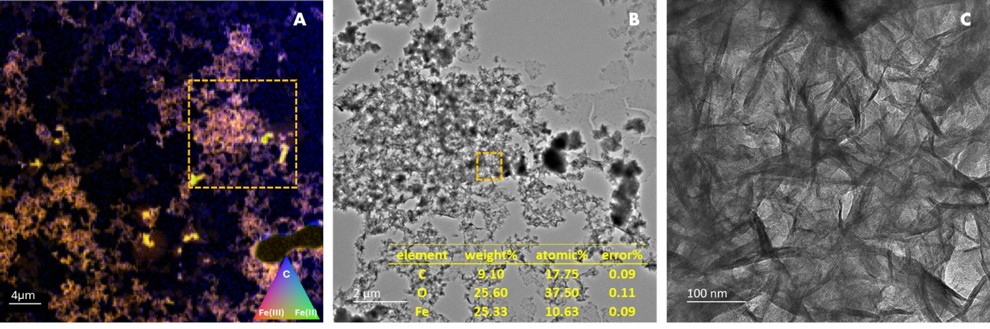
Figure 1. Scanning transmission X-ray microscopy and transmission electron microscopy reveal organic carbon closely associated with mixed reduced and oxidized iron phases in porewater colloids from reducing floodplain sediments.
The Science
Floodplains strongly influence the chemistry of water that flows into rivers. In these environments, changes in oxygen levels (redox conditions) can alter how carbon and metals move through soils. Researchers studied porewater from different depths in a mountainous floodplain in Colorado to determine the composition of organic colloids—tiny particles that transport carbon and metals. Using advanced X-ray microscopy and electron microscopy, they found that reducing (non-oxygenated) conditions resulted in colloids rich in carboxylate-containing organic matter and iron. In contrast, in non-reducing (oxygenated) zones more aromatic- and phenol-rich organic carbon that was not associated with iron was present. These results show that redox gradients control the type and mobility of organic colloids in floodplains, and thus what can be transported into the river.
The Impact
Organic colloids play a major role in transporting carbon, nutrients, and metals through watersheds. This study shows that changes in oxygen availability in floodplain soils can alter the composition and mobility of these particles. Under reducing conditions, iron- and carboxylate-rich colloids form and may move through into the river. These processes can influence carbon cycling, microbial activity, and metal transport in mountain watersheds. Understanding how redox dynamics control colloid formation improves predictions of how floodplains regulate water quality and carbon export under changing environmental conditions.
Summary
Floodplains act as biogeochemical reactors where groundwater and surface water interact. In this study, researchers examined the composition of porewater colloids across a depth-dependent redox gradient in a riparian floodplain along the Slate River in Colorado, U.S.A. Porewater was sampled from reducing and oxygenated zones and analyzed using correlated scanning transmission X-ray microscopy (STXM; performed at the Advanced Light Source, California, U.S.A.) and transmission electron microscopy (TEM).
The results showed that the most reducing zone (~200 cm depth) contained the highest concentrations of dissolved and colloidal organic carbon, as well as abundant Fe(II). Colloidal organic matter in this zone was dominated by carboxylate-rich functional groups and often occurred together with a mixture of reduced and oxidized iron assemblages. Radiocarbon measurements revealed that porewater carbon in this layer was younger than carbon above and below it, suggesting that buried organic-rich sediments may provide bioavailable carbon that fuels microbial respiration and drives iron reduction. In contrast, oxygenated zones contained older organic matter that was more aromatic and phenolic-rich and was not co-associated with iron.
These findings demonstrate that redox cycling is linked to the concentration and composition of organic-mineral colloids in floodplain soils and may influence how carbon and iron are exported from floodplains to rivers.
Contact
Brandy D. Stewart
SLAC National Laboratory
stewartb@slac.stanford.edu
Eoin L. Brodie, Watershed Function SFA LRM
Lawrence Berkeley National Laboratory
Funding
This work was supported by the Watershed Function Science Focus Area at SLAC Accelerator Laboratory (Contract No. DE-AC02-76SF00515) and at Lawrence Berkeley National Laboratory (Contract No. DE-AC02-05CH11231) funded by the US Department of Energy, Office of Science, Biological and Environmental Research.
Publications
Stewart B.D., Bone S.E., Spielman-Sun E., Marcus M.A., Pierce S., Boye K., Noël V. Organic colloid composition in variable-redox porewaters within a mountainous floodplain. Water Research 295, 125556 (2026). DOI: 10.1016/j.watres.2026.125556