
Challenges and Perspectives in Understanding Elemental Transport in Complex Environmental Systems
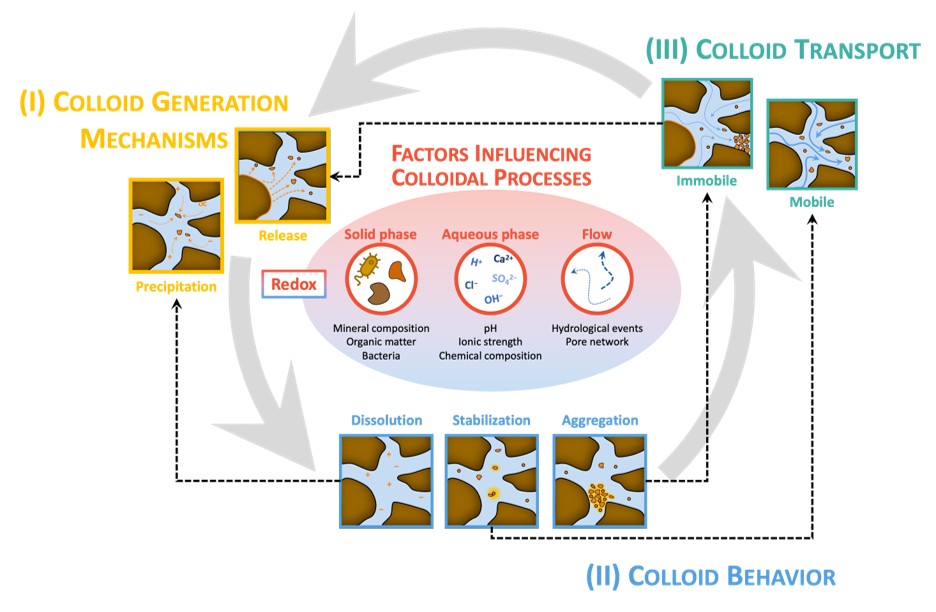
Image courtesy of Spielman-Sun et al. (2024) ACS Earth and Space Chemistry. 8 (4), 630-653.
Image Caption: Life cycle of natural colloids in the environment.
The Science
Owing to their high ability to complex with organics, nutrients, heavy metals, and pollutants, colloids — tiny particles ranging from 1 nm to 1 µm that are suspended in water — are important carriers of these critical substances to groundwaters and rivers, impacting the water quality. The behavior of colloids in systems affected by redox conditions (alternating oxygen-rich and oxygen-depleted environments) is, however, not well understood. The complex interactions between colloidal characteristics, redox reactions, and environmental conditions make it difficult to predict colloid behavior, generating major uncertainties in quantitative assessments of element exports.
The Impact
Understanding the behavior of colloids in redox-dynamic environments is essential for predicting and managing the fate and transport of nutrients, organics, and contaminants in environmental systems. This study highlights the need for further research in this area and provides a framework for advancing our knowledge of mobilized fractions in complex natural systems. The summarized findings from the literature suggest colloids have significant impacts on fields such as engineering, ecology, and, importantly, strategies for managing and mitigating water resources quality challenges.
Summary
This review paper critically examines the current state of knowledge on colloid generation, stability, and transport under redox-dynamic conditions. We assess the challenges and limitations of existing research and underscore the need for a more comprehensive understanding of these complex systems, which are influenced by both natural processes and human activities. Through a detailed review of the literature, we identified key knowledge gaps, including the lack of a universally accepted cross-disciplinary definition of colloids and modeling infrastructure that hamper an in-depth understanding of colloid generation, behavior, and transport potential. We propose that colloids are critical components of element budgets in redox-dynamic systems and it is necessary to go beyond a size-based operational definition of colloids and consider the functional differences between colloids and dissolved species. To predict colloidal transport in redox-dynamic environments, more empirical data are needed to parametrize and validate models. Thus, colloids should urgently be considered in field as well as lab experiments and reactive transport models. We hope this review will help to bring further clarity and openness in reporting colloidal measurements and fate to improve consistency between studies. Additionally, we suggest a methodological toolbox for examining impacts of redox dynamics on colloids in field and lab experiments.
Contact
Vincent Noël, SFA Science Lead
STAFF Scientist, SLAC National Accelerator Laboratory
Eoin L. Brodie, Watershed Function SFA LRM
Lawrence Berkeley National Laboratory
Funding
Funding was provided by the U.S. Department of Energy (DOE) office of Biological and Environmental Research (BER), Environmental System Sciences Division, through its support of the SLAC Floodplain Hydro- Biogeochemistry Science Focus Area (SFA) under Contract No. DE- AC02- 76SF00515.
Publications
Eleanor Spielman-Sun, Kristin Boye, Dipankar Dwivedi, Maya Engel, Naresh Kumar, Aaron Thompson, Vincent Noël. A Critical Look at Colloid Generation, Stability, and Transport in Redox-Dynamic Environments: Challenges and Perspectives. ACS Earth and Space Chemistry 2024 8 (4), 630-653.
[DOI: 10.1021/acsearthspacechem.3c00255]