
Linking water movement across landscapes to improve scientific understanding, enhance models, and support effective ecosystem and watershed management.
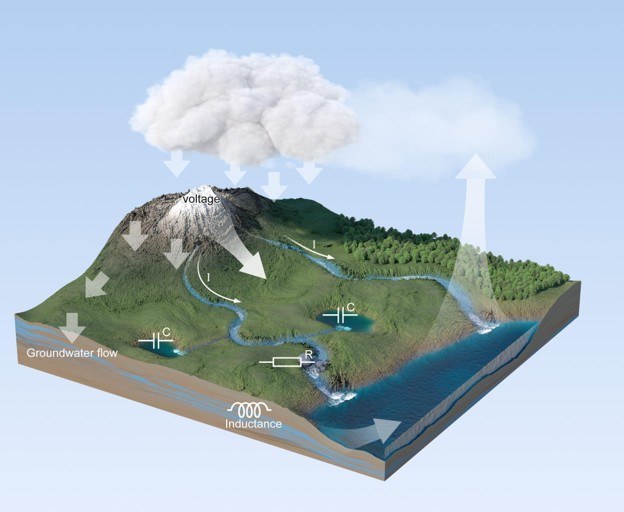
Figure: Conceptual analogy of hydrologic connectivity as an electric circuit: voltage drives flow, resistors slow it, capacitors store water, and inductors reflect delayed responses—figure courtesy of Ella Maru Studio.
The Science
This research topic—Investigating Connectivity to Advance the Predictive Understanding of Watershed Processes and the Earth’s Critical Zone—explores how water moves through landscapes, carrying nutrients and sediment that affect ecosystems and water quality. Understanding this hydrologic connectivity requires integrating knowledge across surface, subsurface, and atmospheric systems. The collection comprises eight papers—an impressive number, given the topic’s complexity—reflecting a broad and growing interest. These studies advance theory, field methods, and modeling, examining how features such as topography, wood, and tectonics shape connectivity, and how tools like AI and real-time sensing can enhance watershed prediction and management.
The Impact
This Research Topic advances understanding of hydrologic connectivity by uniting diverse disciplines and tools, ranging from conceptual models and AI-based techniques to sediment-nutrient interactions and tectonic dynamics. The eight papers reflect both the complexity and urgency of this topic, given the challenges of climate change, land-use pressures, and water management. Together, they provide new frameworks and insights that can inform ecosystem restoration, improve water quality, and enhance resilience across scales. By linking theory, modeling, and practical management, this work equips scientists and practitioners to better predict and manage watershed responses under future environmental stressors.
Summary
This Research Topic—Investigating Connectivity to Advance the Predictive Understanding of Watershed Processes and the Earth’s Critical Zone—brings together eight interdisciplinary studies that explore how hydrologic connectivity influences the movement of water, sediment, and nutrients across landscapes. Hydrologic connectivity refers to the water-mediated transfer of materials and energy within and between components of the watershed. Traditionally studied in isolation, this process spans the surface, subsurface, and atmospheric domains, requiring integration across disciplines such as hydrology, geomorphology, and biogeochemistry.
The collection highlights a wide range of approaches, including field-based observations, conceptual frameworks, process-based modeling, and data-driven techniques. Topics covered include the effects of topography and streambed complexity on flow dynamics, the role of wood in channel structure and sediment transport, the influence of tectonic setting on hydrologic patterns, and the application of artificial intelligence and graph theory to improve model accuracy. Several studies also examine ecohydrologic interactions and nutrient exports from agricultural landscapes, illustrating the link between connectivity and ecosystem health.
Collectively, the papers emphasize the need for unified metrics, cross-scale modeling, and real-time monitoring to improve the prediction of watershed behavior. These insights support science-informed decision-making for ecosystem restoration, climate adaptation, and sustainable watershed management. The Research Topic underscores the growing importance and application of hydrologic connectivity in Earth system science.
Contact
Dipankar Dwivedi
Lawrence Berkeley National Laboratory
Eoin L. Brodie, Watershed Function SFA LRM
Lawrence Berkeley National Laboratory
Publications
Dwivedi, D., Pöppl, R. E., & Wohl, E. (Eds.). (2025). Investigating Connectivity to Advance the Predictive Understanding of Watershed Processes and the Earth’s Critical Zone. Frontiers Media SA.