
Novel tracer methods work in an interdisciplinary framework, leading the path to understanding soil-plant interactions
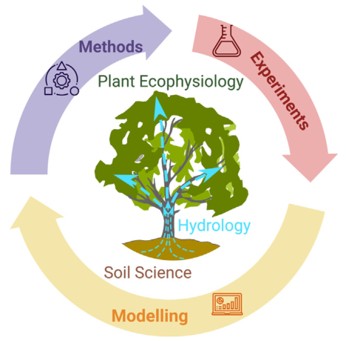
To improve research on the water fluxes in the soil-plant-atmosphere continuum, we need to move from disciplinary studies of soil, plant ecophysiology and hydrology to an interdisciplinary approach to building common models, approaches and methodologies.
The Science
This commentary reflects on a discussion among water, plant, and soil scientists. We outline open questions and opportunities for collaborative water-related research, with a focus on tracking water fluxes between soils, plants, and the atmosphere. We present ways forward in terms of tracer methods, experiments, and modeling and highlight the need to move towards an interdisciplinary approach of building common models, experiments and methodologies.
The Impact
Studying how water moves between soil, plants, and the atmosphere is important to understand water cycling and behavior, and how it may change with a changing climate. The commentary will guide the community towards deepened collaborations across disciplines, indetending to inspire work towards solutions that preserve, restore and protect natural systems against climate change impacts.
Summary
Many of the dynamic interactions generated by water fluxes between soil, plants and the atmosphere are not well understood, which is partly due to a lack of interdisciplinary research. Tracing and quantifying water is crucial for understanding ecohydrological systems and their vulnerability to environmental change. The interface between ecosystems and the atmosphere is strongly mediated by plants and is important to understand in order to meaningfully describe ecohydrological system functioning.
This opinion paper reflects a discussion among hydrologists, plant ecophysiologists and soil scientists on open questions and new opportunities for collaborative research on the topic of water fluxes in the soil-plant-atmosphere continuum, focusing on environmental and artificial tracers. We outline ways forward in terms of tracer methods, experimental work, and modeling efforts in an interdisciplinary framework to trace water fluxes through the soil-plant-atmosphere continuum. We particularly emphasize the need to move from disciplinary studies of soil, plant ecophysiology and hydrology to an interdisciplinary approach of building common models and methodologies.
Contact
Matthias Sprenger
Lawrence Berkeley National Laboratory
msprenger@lbl.gov, 404-804-1116
Eoin L. Brodie, Watershed Function SFA LRM
Lawrence Berkeley National Laboratory
Funding
This work was supported by the US Department of Energy Office of Science under contract DE-AC02-05CH11231 as part of Lawrence Berkeley National Laboratory Watershed Function Science Focus Area.
Publications
Orlowski N, et al. (2023): Challenges in studying water fluxes within the soil-plant-atmosphere continuum: An interdisciplinary perspective on pathways to progress, Science of The Total Environment, 881, 163510, (2023) [doi: 10.1016/j.scitotenv.2023.163510]