
Tree cover was found to be a major driver regulating how much snowmelt sustains the stream discharge in the headwaters of the Colorado River.
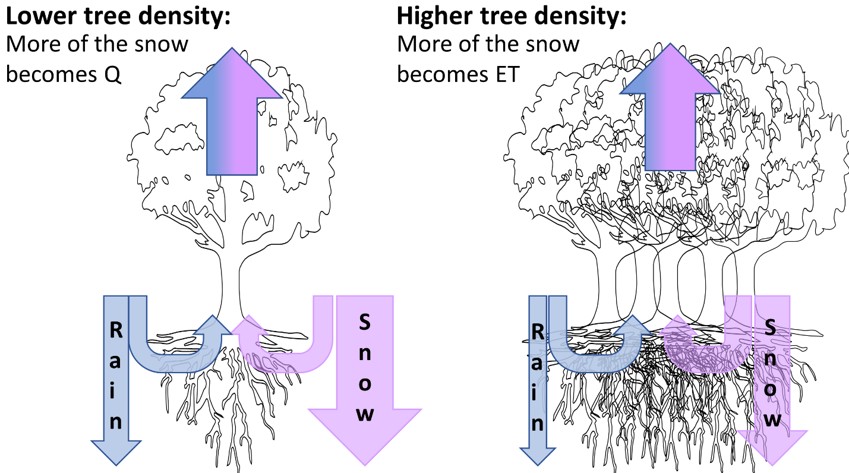
In catchments with higher tree cover density, more of the snow (purple) gets evapotranspired (arrow upwards), but when tree cover is lower, more snow recharges groundwater and streamflow (arrow downwards).
The Science
Snowmelt from the Rocky Mountains is crucial for the Colorado River water supply. We applied a stable isotope mass balance approach to investigate how much of the snow contributes to streamflow and how much returns to the atmosphere via evapotranspiration (ET) in nine mountainous catchments. We found that snow sustains about ¾ of the ET and rainfall was mostly (2/3) lost to ET. The variation of the snow and rain contributions to streamflow and ET were mainly driven by the timing of snowmelt (influenced by the average aspect in catchments) and plant water use (influenced by tree cover).
The Impact
Our results underline the special role that snow plays for the water supply of mountainous ecosystems and human use. The correct rain and snow partitioning into different water fluxes need to be accounted for in hydrological models to allow for sound predictions in climate change scenarios. Our results highlight that soil-plant feedbacks are crucial mechanisms that need to be accounted for in simulations. Thus, the isotope mass balance results can serve as a benchmark for particle tracking models.
Summary
Understanding the partitioning of snow and rain contributing to either catchment streamflow or evapotranspiration (ET) is important to inform water management in response to climate change. To investigate this partitioning, we use endmember splitting and mixing analyses based on stable isotope (18O) data from nine headwater catchments in the East River, Colorado. Our results show that one third of the snow partitions to ET and 13% of the snowmelt sustains summer streamflow. Only 8% of the rainfall contributes to the summer streamflow, because most of the rain (67%) partitions to ET. The spatial variability of precipitation partitioning is mainly driven by aspect and tree cover across the sub-catchments. Catchments with higher tree cover have a higher share of snow becoming ET, resulting in less snow in summer streamflow. The findings show that the timing of snowmelt (influenced by aspect) and plant water use (influenced by tree cover) determined how much snow became streamflow and ET. Summer streamflow did not contain more rain with higher rainfall sums, but more rain was taken up in ET.
Contact
Matthias Sprenger
Lawrence Berkeley National Laboratory
msprenger@lbl.gov, 404-804-1116
Eoin L. Brodie, Watershed Function SFA LRM
Lawrence Berkeley National Laboratory
Funding
This work was supported by the US Department of Energy Office of Science under contract DE-AC02-05CH11231 as part of Lawrence Berkeley National Laboratory Watershed Function Science Focus Area.
Publications
Sprenger M., et al.: “Variability of snow and rainfall partitioning into evapotranspiration and summer runoff across nine mountainous catchments”, Geophysical Research Letters, 49(13), e2022GL099324, (2022) [doi: 10.1029/2022GL099324]