
Scientists are advancing microbial trait-based models by developing a computational method that generates microbial traits from genomic information.
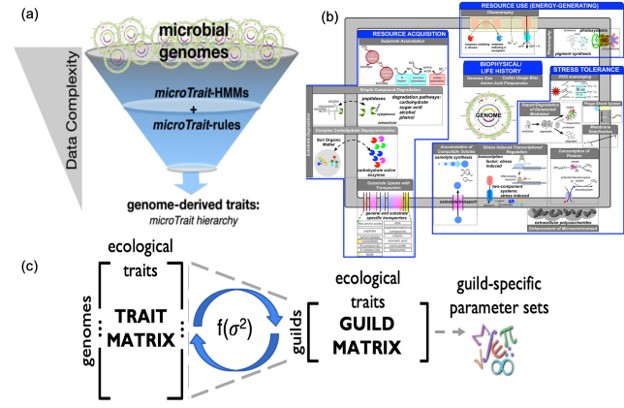
Figure: (a) microTrait pipeline consists of a library of gene-level Hidden Markov Models (microTrait-HMMs) for detection of genome features and logical rules (microTrait-rules) that map these features to traits. (b) Conceptual overview of genome-derivable traits (gray boxes) underlying ecological strategies (blue boxes) represented in microTrait based on literature surveys. For each trait, genomic features are indicated. (c). With genome-derived trait matrix, microbial guilds (groups of microbes contributing to the same ecological function) are defined in a data-driven manner that is key to link genomic data to trait-based models.
Image credit: Ulas Karaoz, LBNL
The Science
In microbial ecology, our remote window into the ecology of microorganisms is through the lens of genome sequencing, which determines the genetic makeup of an organism. The rate at which current genomes are generated has significantly increased, giving new insights into ecological processes and interactions. Extraction of ecologically relevant traits from big genomic data to inform trait-based models will be essential to the future of microbial ecological research.
The Impact
Microbial organisms perform key functions in ecosystems, such as organic matter decomposition, and understanding microbial traits can help inform ecosystem processes and allows scientists to model and predict them in a changing climate. This study presents microTrait, a computational pipeline that infers ecologically relevant traits from microbial genome sequences. microTrait takes a genome sequence and extracts quantitative traits. These traits can be inferred from specific genes and pathways representing energy generation, resource acquisition, and stress tolerance mechanisms, while genome-wide signatures are used to infer life history traits like maximum potential growth rates. The authors present an approach to define microbial guilds (groups of microbes contributing to the same ecological function) in a data-driven manner that is key to linking genomic data to trait-based models. This approach can be applied to any microbial habitat, while initial examples are provided with reference to soil microbiomes.
Summary
Genome sequencing, from a data perspective, now provides insight into the traits that regulate fitness and function across Earth’s microbiomes. Genomes are increasingly recognized as a fundamental unit in the study of microorganisms, however, integration of this information is required to understand how such genome units relate to ecological behavior. Studying feedbacks between microorganisms and their environments requires numerical modeling approaches, yet the limited assimilation of genomic information has constrained modeling development. This assimilation of microbiome information into numerical models remains a significant challenge as microbial communities are extremely diverse, physiologically flexible, and dynamically adaptive.
The authors focus on mechanistically well-studied traits with genetic underpinnings that have been previously documented. They implemented a genome- to- trait pipeline as an open-source R coding package, microTrait, that provides a conceptual framework and associated pipelines to translate a microbial genome into a suite of potential fitness traits. microTrait maps a genome sequence into a hierarchical structure where traits that represent energy generation, resource acquisition, stress tolerance, as well as life history traits can be organized. Together, it is the combination of these traits that underlie microbial strategies and performance in their habitats. Their pipeline generates a trait matrix, showing which genomes correspond to which traits. In addition, given a set of genomes representing a habitat, microTrait can be used to discover and define functional guilds (groups of organisms with similar characteristics and functions) and to overlay the defined guilds with additional life history traits (e.g. maximum growth rate and optimal growth temperature). The resulting information can be used to inform trait-based models and explore the drivers of patterns in the distribution and occurrence of microbial traits.
Contact
Ulas Karaoz, Computational Biology Research Scientist
Lawrence Berkeley National Laboratory
Eoin L. Brodie, Watershed Function SFA LRM
Lawrence Berkeley National Laboratory
Funding
This work was supported by the Watershed Function Science Focus Area, and the Belowground Biogeochemistry Science Focus Areas at Lawrence Berkeley National Laboratory, funded by the US Department of Energy, Office of Science, Office of Biological and Environmental Research, Environmental System Science program. The work benefited from discussions with organizers and participants at the US National Institute for Mathematical and Biological Synthesis (NIMBioS) Pan-microbial Trait Ecology Workshop at the University of Tennessee, Knoxville, for which the authors are grateful.
Publication
Karaoz, U. and Brodie E.L. “microTrait: a toolset for a trait-based representation of microbial genomes.” Frontiers in Bioinformatics. 22;2:918853 (2022) [doi.org/10.3389/fbinf.2022.918853]
Related Links
Open source code: https://github.com/ukaraoz/microtrait