
A field-based study reveals the influence of redox regimes on uranium accumulation during bioremediation.
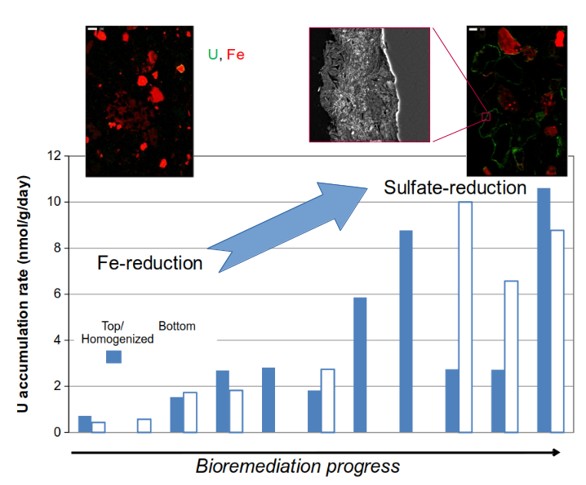 |
Image courtesy of Janot et al. (2024) ACS Earth and Space Chemistry, 8, 148-158.
Image Caption: Sulfate-reducing conditions maximize U(IV) accumulation, concentrating in grain coatings where new sulfide minerals form.
The Science
This field study investigated how changing redox conditions influence the chemical form and spatial distribution of uranium in contaminated aquifer sediments during bioremediation. The authors conducted time-resolved experiments in the Rifle, Colorado, floodplain aquifer, using acetate injections to stimulate microbial reduction of uranium. The study found that non-crystalline U(IV) was the predominant species in all cases, but accumulation rates increased significantly under sulfate-reducing conditions, coinciding with the formation of FeS mineral grain coatings that served as reduction hotspots.
The Impact
The findings provide critical new insights for refining reactive transport models (RTMs) of uranium behavior in subsurface environments. Specifically, the results highlight:
· that non-crystalline U(IV), which is more susceptible to reoxidation, dominates under both iron- and sulfate-reducing conditions;
· the importance of sulfate-reducing conditions in maximizing U(IV) accumulation;
· that spatially resolved data are essential to constrain and parameterize models, especially since bulk aqueous data alone cannot capture key pore-scale dynamics.
This knowledge will enhance the predictive capability and design of long-term in situ bioremediation strategies for uranium-contaminated sites.
Summary
To evaluate how uranium reduction and accumulation evolve during biostimulation, the authors deployed sediment-packed column reactors directly into the Rifle aquifer and amended the groundwater with acetate and uranium. Combining aqueous chemistry, chemical extractions, and high-resolution synchrotron X-ray mapping, the authors:
· identified a clear transition from Fe-reducing to sulfate-reducing conditions in sediment columns;
· demonstrated that sulfate-reducing conditions lead to faster uranium accumulation, due to the formation of FeS-coated grain surfaces;
· confirmed that the dominant U species under all conditions was non-crystalline U(IV), associated with biomass and mineral coatings.
This study confirms that controlling biogeochemical regimes—specifically achieving sulfate-reducing conditions—is key to enhancing uranium retention in subsurface environments.
Contact
Vincent Noël, SFA Science Lead
STAFF Scientist, SLAC National Accelerator Laboratory
Eoin L. Brodie, Watershed Function SFA LRM
Lawrence Berkeley National Laboratory
Funding
This work was supported by the U.S. Department of Energy (DOE) Office of Biological and Environmental Research, Subsurface Biogeochemical Research program (FWP 10094), and the SLAC Floodplain Hydro-Biogeochemistry Science Focus Area under DOE Contract DE-AC02-76SF00515.
Publications
Noémie Janot, Sarrah M. Dunham-Cheatham, Juan S. Lezama Pacheco, José M. Cerrato, Daniel S. Alessi, Vincent Noël, Eunmin Lee, Don Q. Pham, Elena Suvorova, Rizlan Bernier-Latmani, Kenneth H. Williams, Philip E. Long, and John R. Bargar (2024) Reducing Conditions Influence U(IV) Accumulation in Sediments during In Situ Bioremediation. ACS Earth and Space Chemistry, 8, 148-158.
[DOI: 10.1021/acsearthspacechem.3c00271]