
How geology and seasonal drying control stream water sources
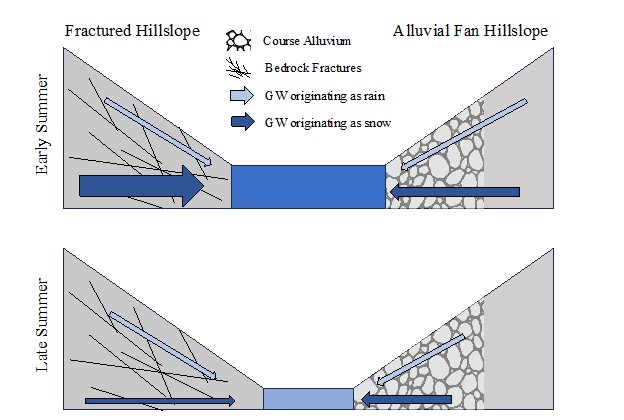
Image: Conceptual diagram of groundwater originating from snow and rain recharging stream water under fractured and alluvial fan hillslopes during early and late summer. In early summer, groundwater that originated from snow dominated the fractured hillslope, while in late summer groundwater flow declined and was equally composed of snow and rain. Unlike the fractured hillslope, groundwater that originated from the alluvial fan was consistent in volume and its snow-dominated composition. Early in the summer, the alluvial fan and area upslope of the fan contributed groundwater to the stream, while later in the summer the upslope became disconnected, and the alluvial fan was the dominant water source. Height of the arrows indicate the relative proportion of groundwater that originated from rain or snow to the stream. Image from Keira Johnson.
The Science
Stream water samples were collected throughout a summer and analyzed them for two different environmental tracers: radon (222Rn), which is higher in groundwater and helps pinpoint where it enters the stream, and water stable isotopes (δ18O and δ2H), which indicate if the water came from snowmelt or rain and suggest flow paths. Samples were used to parameterize a groundwater flux model to estimate groundwater input along different stream sections. The study revealed that groundwater flow into the stream changed significantly over the summer. Early in the summer, when the ground was wetter, a large amount of groundwater came from areas with bedrock fractures, but this flow decreased as the summer dried out. In contrast, areas with alluvial fans provided a more constant supply of groundwater flow throughout the summer, becoming proportionally more important later in the season. This shift was linked to declining hydrologic connectivity as the subsurface dynamic storage drained. Water isotope data supported this, showing a shift from streamflow being more snow-dominated early in the summer to having a higher proportion of water from recent summer rains later on, reflecting a greater reliance on shallower flow paths as connectivity decreased.
The Impact
Understanding the influence of local geology on groundwater surface water interactions is crucial for predicting how mountain streams will respond to warmer temperatures and declining snowpacks. Streams will become increasingly reliant on groundwater during drier summer months. Geological features with high storage capacity, like alluvial fans, may become increasingly important for sustaining streamflow during prolonged dry periods. Knowing which geological features contribute water and when, based on their storage capacity and connectivity, allows for better forecasting of streamflow under future warming scenarios. This knowledge is essential for managing vital water resources for both human use and the ecosystems that depend on these vulnerable streams. This understanding can also aid in studying the transport of contaminants, such as metals from mining, in these areas.
Summary
Mountain streams face increasing reliance on groundwater with warmer temperatures, reductions in snowpack, and longer and drier summers. This study in Coal Creek, Colorado, investigated how specific geological features – bedrock fractures and alluvial fans – control groundwater inputs to the stream. Using radon and water isotopes, researchers tracked water sources over a summer. The findings show groundwater contributions shifted significantly as the summer progressed. Areas with fractured bedrock provided high groundwater flow early in the season but decreased as conditions dried. In contrast, alluvial fans provided a more constant groundwater supply, becoming proportionally more important later in the summer. This shift is linked to surface-subsurface connectivity as the water stored in the shallow subsurface drains. Water isotopes confirmed a change from snowmelt-dominated streamflow to a greater contribution from recent rain later in the season, reflecting shallower flow paths. This research highlights that local geology is critical for sustaining summer streamflow. Features with high storage, like alluvial fans, are expected to become increasingly important for maintaining flow during future dry periods. Understanding these geological controls is vital for predicting stream response to warming and managing crucial water resources.
Contact
Eoin L. Brodie, Watershed Function SFA LRM
Lawrence Berkeley National Laboratory
Keira Johnson
Oregon State University
Funding
This material is based upon work supported by the National Science Foundation under Grant No. (PL Sullivan: NSF 2034232, and 2012796) and the Department of Energy under Grant No. (PL Sullivan + L Li: DE-SC0020146). K.H.W., J.N.C., R.W.H.C and M.S. are supported by the US Department of Energy Office of Science under contract DE-AC02- 05CH11231 as part of Lawrence Berkeley National Laboratory Watershed Function Science Focus Area.
Publications
Johnson, K., Christensen, J.N., Gardner, W.P., Sprenger, M., Li, L., Williams, K.H., Carroll, R.W.H, Thiros, N., Brown, W., Beutler, C., Newman, A., & Sullivan, P.L. (2024). Shifting groundwater fluxes in bedrock fractures: Evidence from stream water radon and water isotopes. Journal of Hydrology. 10.1016/j.jhydrol.2024.131202