
A computer model reveals how snowmelt, topography, and rock chemistry together control carbon storage and water quality in a Colorado shale hillslope.
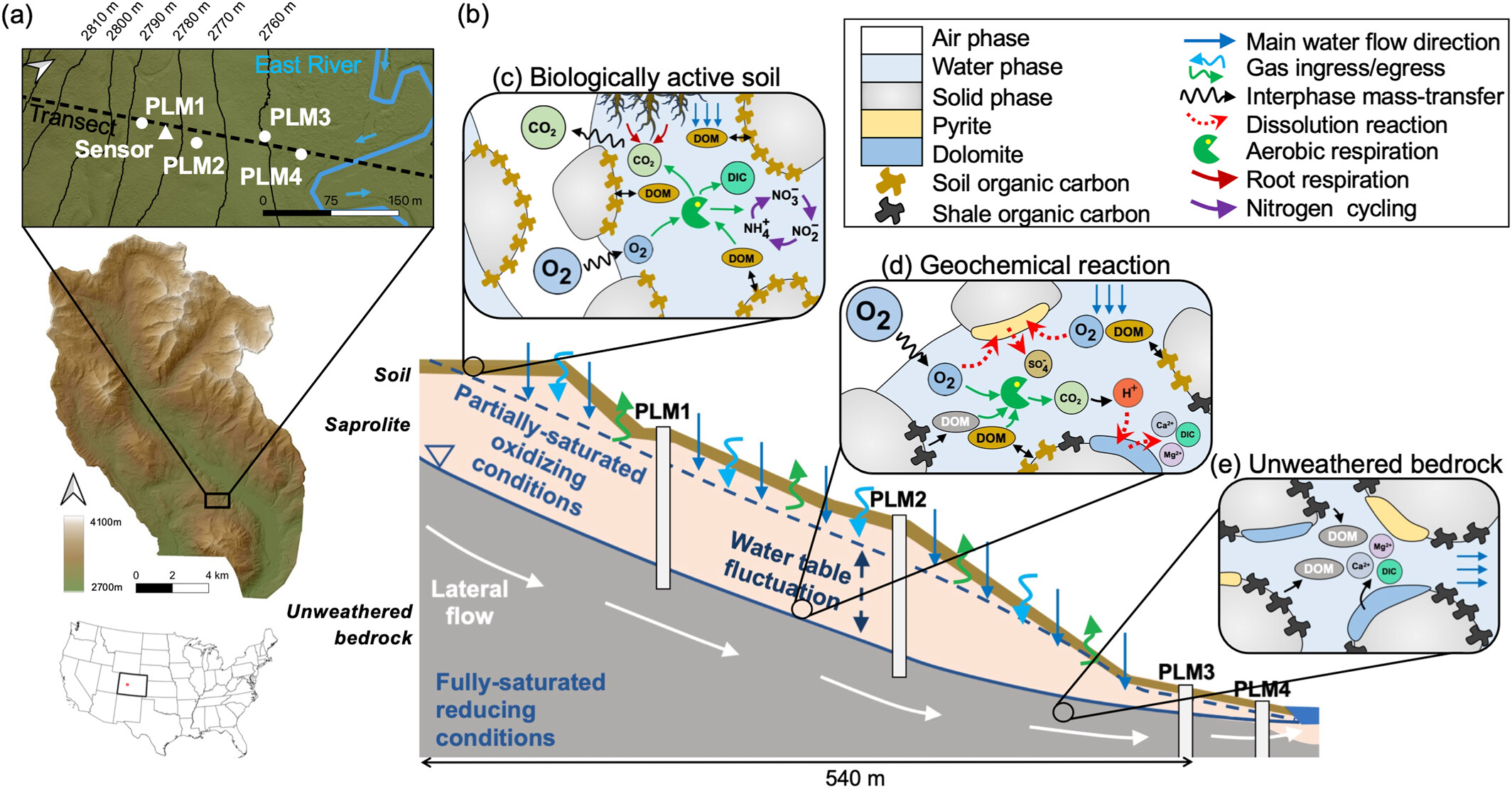
Schematic of the East River hillslope showing monitoring well locations, groundwater flow paths, and geochemical reaction fronts for pyrite and dolomite, with close-up panels of biogeochemical reactions in three subsurface zones: soil, reaction front, and bedrock. Image courtesy of Stolze et al. (2026), open access (CC BY-NC-ND 4.0)
The Science
Shale rocks cover large areas of mountain watersheds and hold enormous amounts of ancient carbon as well as other important elements. When shale weathers — slowly breaking down from contact with water and air — it affects both stream water quality and the global carbon cycle. However, scientists have lacked models capable of capturing how snowmelt, seasonal temperature swings, hillslope steepness, and interacting chemical reactions together control how much carbon is stored underground versus released to the atmosphere.
The Impact
Understanding how mountain rocks weather helps us predict water quality in streams and rivers that millions of people depend on. It also helps us track how much CO2 enters or leaves the atmosphere through natural processes. This research shows that shale weathering acts as a short-term carbon sink — briefly storing CO2 — but releases more carbon over longer timescales. As snowpack melts earlier in the western United States, these findings suggest that shale-rich watersheds could shift from storing carbon to releasing it, with consequences for both water quality and availability.
Summary
Researchers developed a detailed two-dimensional reactive transport model to simulate how water, gases, and minerals interact within a shale-underlain hillslope at the East River watershed in Colorado’s Rocky Mountains. The model couples soil respiration, groundwater flow, multiphase gas transport, and geochemical reactions under seasonally changing conditions driven by snowmelt. It was validated against five years of field measurements of water chemistry, soil CO₂, and water table dynamics collected from instrumented monitoring wells. Key findings show that spring snowmelt is the dominant driver of carbonate mineral dissolution, increasing dolomite weathering rates by more than 350% compared to winter baseflow. In contrast, pyrite oxidation — which releases sulfuric acid and CO2 — is controlled primarily by how dry the soil is, which determines how much oxygen can diffuse into the ground. Steeper slopes drain more efficiently, lowering the water table and allowing more oxygen diffusion, which accelerates pyrite oxidation. At the same time, steeper slopes enhance snowmelt infiltration, delivering more CO2-charged water to depth and driving greater carbonate weathering. The model reveals that shale weathering at this site currently draws down approximately 1% of soil-derived CO2, making it a short-term carbon sink. However, about 73% of the dissolved inorganic carbon exported to the river is geogenic — derived from ancient carbon in the rock rather than from the atmosphere. When accounting for the eventual release of that carbon during marine carbonate precipitation over geological timescales, the site functions as a net CO2 source. These simulations were performed on the Perlmutter supercomputer at the National Energy Research Scientific Computing Center (NERSC), a DOE Office of Science user facility.
Contact
Lucien Stolze (lead author)
Lawrence Berkeley National Laboratory
Eoin L. Brodie, Watershed Function SFA LRM
Lawrence Berkeley National Laboratory
Funding
This work was supported by the Watershed Function Science Focus Area project at Lawrence Berkeley National Laboratory, funded by the U.S. Department of Energy, Office of Science, Biological and Environmental Research, under Contract No. DE-AC02-05CH11231. Computing resources were provided by the National Energy Research Scientific Computing Center (NERSC), a DOE Office of Science user facility, under NERSC awards BER-ERCAP28550 and BER-ERCAP33789.
Publications
Stolze, L., Dwivedi, D., Steefel, C., Molins, S., Dong, W., Beutler, C., et al. (2026). Model‐based interpretation of solute exports and carbon partitioning during shale weathering in a mountainous hillslope. Water Resources Research, 62, e2025WR041597. https://doi.org/10.1029/2025WR041597