
Evidence from field observations and hydrologic modeling in a mountain headwater catchment
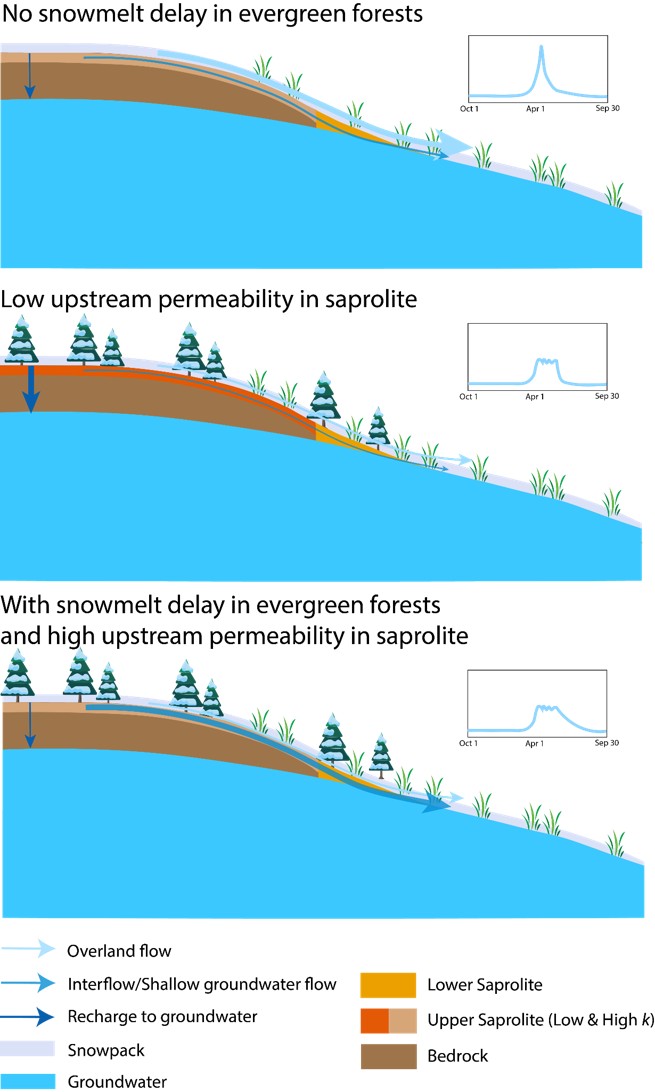
Figure: A conceptual model of headwater stream discharge with vegetation and subsurface transitions. Created by Lijing Wang.
The Science
Mountain headwater streams provide critical water for downstream rivers and communities. Their flow depends on both snowmelt and groundwater, but predicting the timing and amount of water is challenging because snow melts at different rates under different vegetation, and subsurface structures vary in their capacity to store and release water. In this study, we investigated a small catchment near Crested Butte, Colorado, using extensive field data and hydrologic models. Measurements included snow depth, groundwater levels, stream discharge, and geophysical surveys. By integrating these observations with ensembles of the Advanced Terrestrial Simulator (ATS), we revealed how vegetation, snowmelt, and subsurface heterogeneity jointly shape streamflow in mountain headwaters.
The Impact
The research showed that slower snowmelt under evergreen forests delayed peak streamflow, while subsurface permeability and porosity strongly controlled how water was stored and released. Low-permeability zones limited water release from upstream and reduced late-season flow, and contrasts between granodiorite and Mancos shale produced double peaks in groundwater levels. Incorporating multiple datasets into machine learning-based model calibration reduced uncertainty and improved streamflow predictions. These findings highlight that snowmelt dynamics largely control the timing and magnitude of peak flows, while subsurface heterogeneity governs water storage and release that sustain streamflow during recession and low-flow periods, emphasizing the need to characterize subsurface structure for predicting drying and wetting schemes of headwater streams.
Summary
Mountain headwater streams are critical water sources for downstream ecosystems and communities, yet their flow is difficult to predict because of the combined effects of snowmelt variability and complex subsurface structure. This study investigated a small mountain catchment near Crested Butte, Colorado, using a model-data integration framework that combined extensive field measurements with ensembles of the Advanced Terrestrial Simulator (ATS). Field observations included snow depth from distributed temperature sensors across different vegetation types, groundwater levels from wells and piezometers, stream discharge, and electrical resistivity tomography.
Results show that snowmelt under evergreen forests is slower, delaying peak streamflow. Subsurface properties strongly regulate the storage and release of water: low-permeability zones trap water upstream, reducing downstream flow during recession periods, while contrasts between granodiorite and Mancos shale generate distinctive double peaks in groundwater levels. By calibrating models with multiple datasets using machine learning-based approaches, uncertainty in snowmelt and subsurface parameters was substantially reduced, improving predictions of streamflow dynamics. These findings demonstrate how vegetation, snowmelt, and subsurface structure interact to control water availability in mountain streams, and emphasize the need to characterize subsurface structure (spatial heterogeneity, porosity and permeability) to predict streamflow in headwaters, especially during recession and baseflow periods.
Contact
Lijing Wang, Assistant Professor, Department of Earth Sciences, University of Connecticut; Affiliated Faculty, Lawrence Berkeley National Laboratory lijing.wang@uconn.edu
Eoin L. Brodie, Watershed Function SFA LRM
Lawrence Berkeley National Laboratory
Funding
This work was supported by the Watershed Function Science Focus Area at Lawrence Berkeley National Laboratory funded by the US Department of Energy, Office of Science, Biological and Environmental Research under Contract No. DE-AC02-05CH11231. This research also used resources of the National Energy Research Scientific Computing Center (NERSC), a Department of Energy Office of Science User Facility using NERSC award m2398 from 2023 to 2025.
Publications
Wang L., et al., The Role of Snowmelt and Subsurface Heterogeneity in Headwater Hydrology of a Mountainous Catchment in Colorado: A Model-Data Integration Approach, Water Resources Research (2025) [DOI:10.1029/2025WR040651]