
Novel approaches identify distinct watershed traits regulating nitrogen release from adjacent catchments.
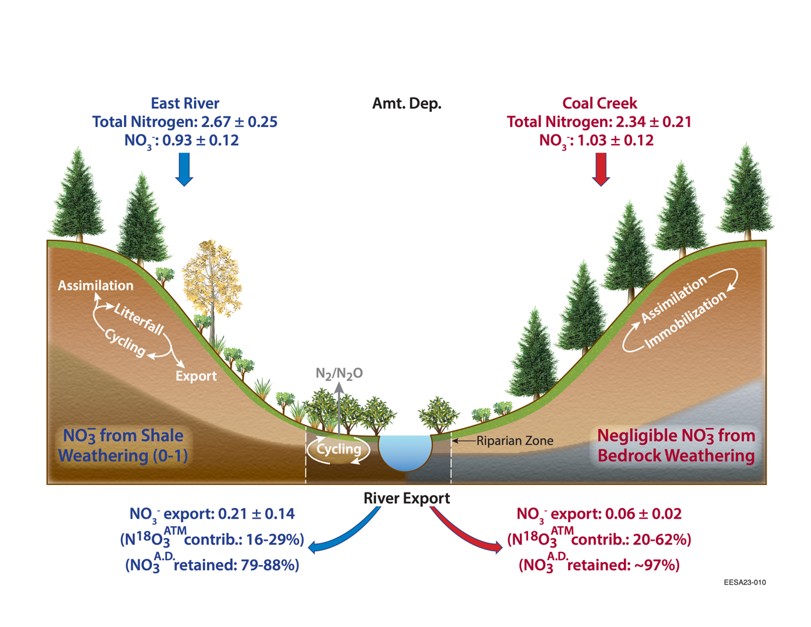
Catchments with distinct traits, including vegetation types and bedrock properties, cycle nitrogen very differently, which has strong implications for future watershed retention of nitrogen and downstream water quality.
The Science
Nitrogen is a nutrient that is critical for ecosystem function. Determining how nitrogen enters, cycles, and is lost from watersheds is integral to predicting how the nitrogen cycle will respond to climate change. Using novel analyses, a multi-institutional team of researchers show that conifer forest-dominated watersheds hold on to the majority of their nitrogen. In addition, the nitrogen that is lost into headwater streams from these watersheds is never assimilated into the ecosystem. By contrast, a watershed with a mixed vegetation type (conifers, aspen, meadows) cycles nitrogen more frequently throughout the year, and releases more to their headwaters.
The Impact
Mountainous ecosystems are facing a future that is warmer and drier, which can make these environments more vulnerable to other changes and disturbances. For example, forests could die, and be replaced by meadows. This study illustrates how different watershed properties in mountainous ecosystems have an effect on the retention and release of nitrogen into headwater streams. Contrasts such as this can be used to predict what future nitrogen releases and cycles might look like as these ecosystems respond to a warming climate.
Summary
Within the Upper Colorado River Basin, the East River and Coal Creek drain two landforms that have contrasting vegetative, geologic, and geomorphologic traits. The East River watershed has a diverse vegetation coverage, wide floodplains, and a nitrogen-rich Mancos Shale bedrock. The East River exports 3.5x as much nitrate (NO3–) relative to Coal Creek, which has a conifer-dominated watershed. While this is partly explained by the larger size of the East River, the distinct functional traits of the two catchments foster different nitrogen cycling. A multi-institutional team of researchers showed that physical and biological processes are critical in shaping NO3– export patterns from the East River. Analysis of NO3– isotopes (i.e., δ15NNO3 and δ18ONO3) allowed the team to track nitrogen movement throughout both watersheds and provided data that showed the East River watershed is a strong hotspot for biogeochemical processing of nitrogen. In contrast, the Coal Creek watershed retained nearly all of the NO3– deposited from the atmosphere, and NO3– export was controlled by hydrological traits. This more conservative N-cycle within the Coal Creek watershed is likely due to the abundance of conifer trees and smaller floodplains, which retain more NO3– overall and reduced cycling prior to export. This study highlights the value of using isotopic analyses to link watershed traits to mechanisms of watershed element retention and release.
Contact
Nick Bouskill
Lawrence Berkeley National Laboratory
Eoin L. Brodie, Watershed Function SFA LRM
Lawrence Berkeley National Laboratory
Funding
This material is based upon work as part of the Watershed Function Scientific Focus Area supported by the U.S. Department of Energy, Office of Science, Office of Biological and Environmental Research under contract number DE-AC02-05CH11231.
Publications
Bouskill N.J., et al., A tale of two catchments: Causality analysis and isotope systematics reveal mountainous watershed traits that regulate the retention and release of nitrogen. JGR-Biogeosciences (2024). [doi:10.1029/2023JG007532]