
Microbial Cu-acquisition from sediments depends on mineralogy and adsorption dynamics.
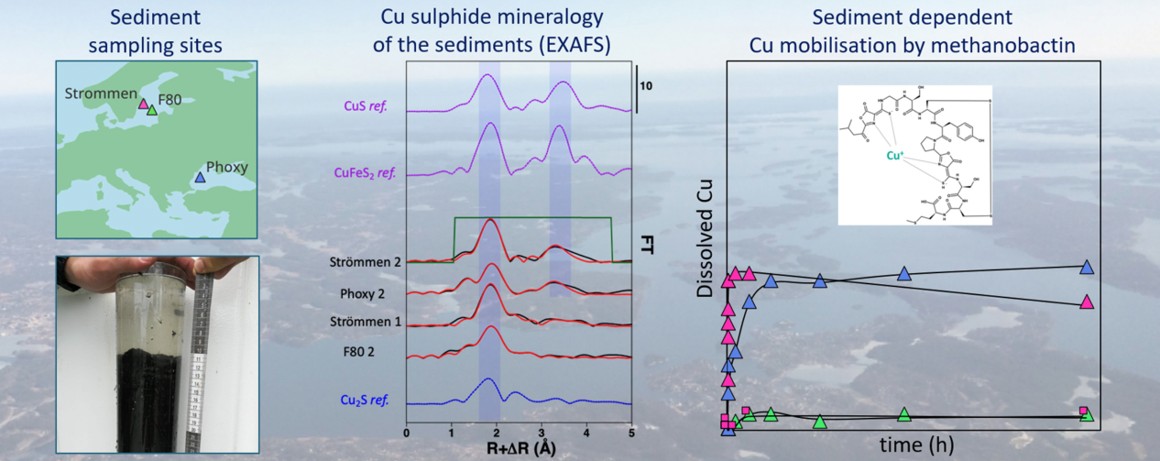 Image courtesy of Rushworth et al. (2024) Science of The Total Environment. 934, 173046.
Image Caption: For similar initial concentrations of copper (Cu) in sediment, Strommen 2 and Phoxy 2 show a higher copper mobilization by methanobactin relative to Strommen 1 and F80. Copper K-edge EXAFS spectra reveal that sediments with higher mobilization of copper are mainly composed of mono-copper sulfide.
The Science
Although marine environments represent huge reservoirs of the potent gas methane, they currently contribute little to global net methane emissions. Most of the methane is oxidized by methanotrophs, minimizing its release to the atmosphere. Aerobic methanotrophs oxidize methane mostly via the copper (Cu)-bearing enzyme particulate methane monooxygenase (pMMO). Because aerobic methanotrophs require both oxygen and methane, these bacteria reside at oxic-anoxic interfaces, often close to sulfidic zones where Cu bioavailability can be limited by poorly soluble Cu sulfide mineral precipitation. This study reveals how copper availability for methane-oxidizing microbes depends on the geochemical form of Cu-sulfide minerals in marine sediments.
The Impact
Our key findings clarify why some methane-oxidizing bacteria may struggle to acquire Cu in sulfidic marine environments — despite its apparent abundance. The work shows:
· Solid-phase speciation — not total Cu — determines bioavailability of Cu for aerobic methanotrophs
· Methanotrophs were able to remobilize Cu when mono-Cu-sulfide minerals like CuS were present
· In contrast, more stable forms such as Cu2S are not bioavailable for methanotrophs
· Methanobactin adsorption can inhibit its availability to complex Cu
This insight helps define where aerobic methane oxidation is limited by trace metal availability, with implications for climate models and ocean methane cycling.
Summary
To investigate copper bioavailability in marine sediments, the authors studied Cu mobilization by methanobactin (mb), a bacterial ligand produced by methane-oxidizing microbes. Through a series of kinetic batch experiments, the authors investigated Cu mobilization by mb from a set of well-characterized sulfidic marine sediments from the Baltic and Black Sea sediments. The ability to mobilize Cu was compared to the solid-phase Cu speciation characterized by X-ray absorption spectroscopy combined with chemical sequential extraction. Furthermore, in batch experiments, the authors investigated to what extent adsorption of metal-free mb and Cu-mb complexes to marine sediments constrains Cu mobilization. The results show that Cu mobilization in natural sediments is highly dependent on mineralogy and adsorption dynamics. This study offers a mechanistic basis for predicting trace metal accessibility in microbial methane filters.
Contact
Walter D.C. Schenkeveld,
Wageningen University,
Eoin L. Brodie, Watershed Function SFA LRM
Lawrence Berkeley National Laboratory
Funding
This study was supported by the Austrian Science Fund (FWF project number 12256-N29), the Marietta Blau-Grant, Austria’s Agency for Education and Internationalisation (OeAD), as well as Swiss National Science Foundation grant SNSF 169951. NAGMvH and CPS were supported by the ERC Synergy grant MARIX (8540088). Additional funding was provided by the SLAC Floodplain Hydro-Biogeochemistry SFA program of the US DOE, Office of Biological and Environmental Research, Earth and Environmental Systems Sciences Division under DOE Contract No. DE-AC02-76SF00515
Publications
Danielle D. Rushworth, Walter D.C. Schenkeveld, Naresh Kumar, Vincent Noël, Jannes Dewulf, Niels A.G.M.van Helmond, Caroline P. Slomp, Moritz F. Lehmann, and Stephan M. Kraemer (2024) Solid phase speciation controls copper mobilisation from marine sediments by methanobactin. Science of The Total Environment. 934, 173046. [DOI: 10.1016/j.scitotenv.2024.173046]