
Soil biological activity controls the weathering of shale and the delivery of solutes in the subsurface.
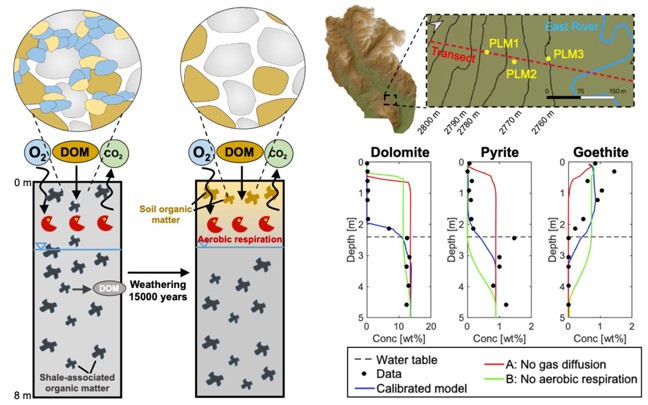
Image courtesy of Lucien Stolze
Multiphase exchange at the atmosphere/subsurface interface and microbial respiration drives the long-term weathering of shale; study hillslope in a mountainous watershed; and stratified weathering fronts measured in the field and simulation outcomes from a reactive transport model.
The Science
The weathering or breakdown of sedimentary rock is an important component of the global carbon, nutrient, and geochemical cycling. Scientists developed a new modeling approach to explore the long-term weathering of shale – a major sedimentary rock that makes up 25% of Earth’s continental rocks. They validated the model using observations from the East River watershed, Colorado and found that that aerobic respiration – the consumption of oxygen and organic matter by microbes to make energy – exerts a key control on shale weathering. They showed that aerobic respiration strongly enhances the removal of carbonate minerals through the production of carbon dioxide and the acidification of the pore water. Furthermore, oxygen consumption by microbes limits the oxidation of sulfide minerals at depth.
The Impact
Shale is a widespread sedimentary rock that represents a large reservoir of carbon due to its high content of fossil organic matter and carbonate minerals. To better estimate global carbon budgets, scientists developed a modeling approach that accounts for the interplay between microbial respiration and mineral reactions. Furthermore, mineral reactions in the subsurface strongly influence the quality of headwaters. The model can be used to explore the impact of global warming on water delivered by mountains by simulating the chemical composition of streams in future climatic scenarios.
Summary
The interface between the Earth’s surface and the atmosphere typically involves complex interactions between hydrological, biogeochemical, and physical processes. Due to this complexity, understanding the mechanisms of shale weathering remains challenging. Scientists implemented a simulator that describes the long-term chemical weathering of Mancos shale (starting from the last glaciation period, 15,000 years ago) at the East River study site, Colorado. The model accounts for gas exchange between the atmosphere and the subsurface, the percolation of water from precipitation, the mass-transfer between the gas and aqueous (solutes in water) phases under partially saturated conditions, and the decomposition of soil and shale organic matter, water-rock interactions. The model was validated on the mineral concentration profiles, solid organic carbon content, and the CO2 gaseous emissions measured in three monitoring wells. The researchers demonstrate that aerobic respiration of organic matter from plant litter is a key control for the development of the saprolite horizon in shale. This microbially-mediated process limits oxygen, which largely prevents the dissolution of pyrite. In contrast, it releases carbon dioxide that drives the removal of carbonate minerals through the acidification of the pore water.
Contact
Lucien Stolze
Lawrence Berkeley National Laboratory
lstolze@lbl.gov
Eoin L. Brodie, Watershed Function SFA LRM
Lawrence Berkeley National Laboratory
Funding
This work was supported by the Watershed Function Science Focus Area project at Lawrence Berkeley National Laboratory and funded by the U.S. Department of Energy, Office of Science, Biological and Environmental Research.
Publications
Stolze L., et al., Aerobic respiration controls on shale weathering. Geochem. Cosmochim. Acta in press (2022). [doi.org/10.1016/j.gca.2022.11.002]