
Identifying the key environmental factors that impact pathogen removal in induced riverbank filtration.
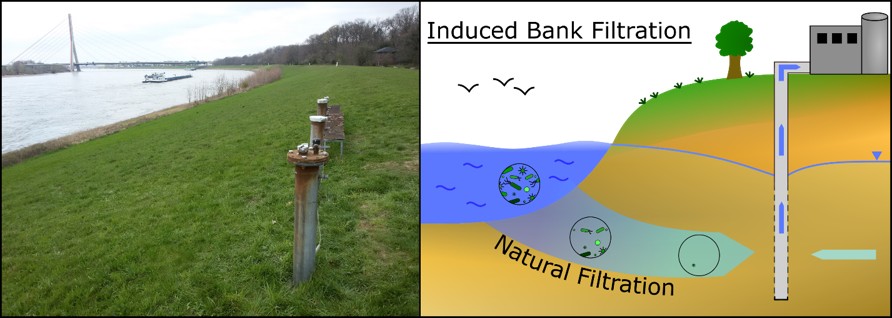
Image by Dustin Knabe, TU Berlin, Germany
Induced bank filtration is a reliable method for sustainable drinking water production.
The Science
Access to safe drinking water is vital for human survival, yet groundwater resources in many regions are increasingly stressed due to growing water demand. To mitigate this issue, induced riverbank filtration has been successfully implemented as a sustainable method for groundwater resource management. The removal of pathogens from groundwater during riverbank filtration is a complex process that depends on various environmental factors such as floods and periods of drought, as well as pumping operations. In this research, a multi-institutional team of researchers used modeling to investigate the effects of specific environmental conditions on pathogen removal in induced riverbank filtration. The team’s results demonstrated that the transport behavior of human pathogenic adenovirus differed significantly from pathogen indicators such as somatic coliphages and coliform bacteria. However, the removal rate of coliforms and somatic coliphages in the aquifer was primarily influenced by reduced travel time. River level changes in rainy seasons and extraction rates at waterworks during dry periods affected this travel time.
The Impact
Induced riverbank filtration is an important method for providing sustainable drinking water, but its effectiveness can be influenced by a variety of environmental conditions that affect pathogen removal. By comparing the modeled transport behavior of human pathogenic adenovirus to that of the indicator species under changing seasonal and other environmental conditions, as well as differences in pumping operations, the team gained insights into the effectiveness of induced riverbank filtration for removing pathogens.
Summary
Water resource management is a key to protecting water resource availability and quality, but pathogens remain a significant contaminant group that can persist after filtration processes. Placing pumping wells along a riverbank directs surface water through a riverbank, where many contaminants are naturally removed as they infiltrate through the soil. However, pathogens such as viruses and bacteria are difficult to remove and remain a significant concern in induced riverbank filtration since they can survive wastewater treatment processes and persist in surface waters.
In this study, a multi-institutional team of researchers analyzed the transport of pathogens at an induced riverbank filtration site in Germany over 15 months. Water samples were collected from the site every two weeks and analyzed for human pathogenic adenoviruses, which are recognized to cause respiratory, ocular, and genitourinary infections, as well as pathogenic indicator species such as somatic coliphages, which are viruses that infect bacteria, and coliform bacteria. To account for natural variations in temperature, oxygen content, river level, pathogen background concentrations, and operational variations in pumping, the research team then developed models of pathogen transport.
The modeling results demonstrated that the transport behavior of human pathogenic adenovirus differed significantly from pathogen indicators such as somatic coliphages and coliform bacteria. River level variations due to rainfall events were found to be the primary factor controlling pathogen removal, whereas natural variations in temperature and oxygen content had minimal impact. Moreover, erosion in the riverbed during flood events was identified as a key process that reduced the removal efficiency of bacterial pathogens.
Contact
Dustin Knabe
Technische Universität Berlin, Germany
Dipankar Dwivedi
Lawrence Berkeley National Laboratory
Paul Bayer
U.S. Department of Energy
Paul.bayer@science.doe.gov
Funding
This material was supported partly by the Watershed Function SFA and The German Federal Environmental Foundation (Deutsche Bundesstiftung Umwelt DBU).
Publications
Knabe, D., Dwivedi, D., Wang, H., Griebler, C., and Engelhardt, I. (2023). Numerical investigations to identify environmental factors for field-scale reactive transport of pathogens at riverbank filtration sites. Advances in Water Resources, 173. https://doi.org/10.1016/j.advwatres.2023.104389