
Isotopic fractionation in the snowpack is overwhelmed by the timing and phase of precipitation.
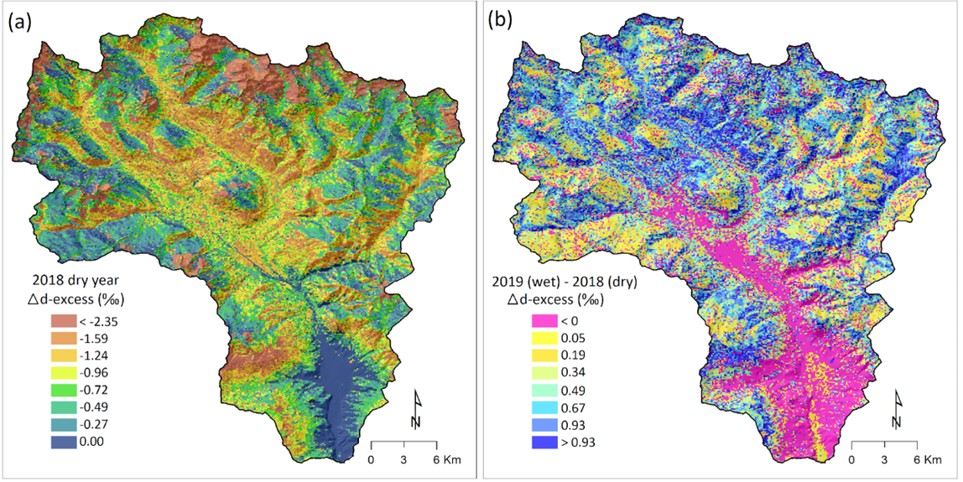
Caption: Simulated spatial distribution across East River, Colo. of a) snowpack changes in d-excess due to isotopic fractionation in snowpack associated with vapor loss (Δd-excess) during a dry water year. The more negative Dd-excess the more fractionation. b) The difference in Δd-excess between wet and dry water years. <0 indicates fractionation increases in a wet water year.
Image credit: Rosemary Carroll et al., 2022, Creative Commons license CC BY-NC-ND
The Science
Water isotopes are used to track vegetation water use and stream water source. Watersheds reliant on snow water inputs alter the timing of stable water isotope inputs through snow storage, while fractionation processes, or the partitioning of lighter and heavier isotopes through phase changes between solid, liquid, and vapor in the snowpack, can potentially change the isotopic input signature of snowmelt. To better understand isotopic inputs to a mountainous basin as a function of climate and landscape position, researchers combined a hydrologic and snowpack stable water isotope model. The coupled model was constrained with a comprehensive isotopic dataset for the East River in Colorado. The approach accounted for snow storage, snowmelt timing, rain-on-snow, and fractionation processes in the snowpack due to melt-freeze cycles and vapor loss.
The Impact
This study found that, annually, the lightest isotopes occur in the upper subalpine environment, where snow accumulation is high, and rainfall is low. Results indicated that incoming spring precipitation during the snowmelt period was most important to snowmelt isotopic evolution over time, while fractionation processes in the snowpack accounted for <25% of snowmelt enrichment in heavy isotopes. Enrichment by vapor loss was least important in the subalpine where the snowpack is deep, shaded from sun by conifer forests, and can be ignored. Vapor loss changes to isotopic inputs in open areas with less snowpack are more important and should be considered. Given the East River is largely energy-limited, wet water years reduce the effect of snowpack vapor loss on isotopic inputs across the basin. The exception was at the lowest elevations where snow-limited conditions are influenced by added snowfall to increase the effect of vapor losses on snowmelt isotopic inputs. Overall, research indicates that the vapor-driven fractionation of snowpack should be considered for isotopic studies in the alpine as well as lower elevation meadows and aspen forests. In contrast, fractionation can be largely ignored in the conifer forests of the upper subalpine where much of the snow resides.
Summary
Researchers combined a hydrologic and snowpack stable water isotope model to understand how landscape position and climate affect isotopic water inputs in a large mountain basin. The lightest isotopes occur in the upper subalpine where snow accumulation is highest and rain inputs are low. The temporal change of isotopes in snowmelt is largely controlled by elevation and its influence on the amount, phase (rain or snow), and isotopic mass of spring precipitation occurring with the snowmelt period. Snowpack alterations account for <25% of total snowmelt enrichment in heavy isotopes. Changes to the snowpack isotopic signature by vapor loss are most important where vegetation does not shade snow, moderate snowfall occurs, and evaporation potential is relatively high. Changes are highest above tree line and in areas with meadows and aspen forests. Vapor loss effects on snowpack are lowest in deep snow found in conifer forests and snow-limited lower elevations. These findings can help scientists more accurately use water isotopes to track water movement through mountain environments.
Contact
Rosemary Carroll
Desert Research Institute
Rosemary.Carroll@dri.edu
Eoin Brodie
Lawrence Berkeley National Laboratory
elbrodie@lbl.gov
Funding
This work was supported by the Watershed Function Science Focus Area at Lawrence Berkeley National Laboratory, which is funded by the Biological and Environmental Research (BER) Program within the U.S. Department of Energy’s (DOE) Office of Science under contract DE-AC02-05CH11231.
References
Carroll, R. W. H., et al. “Modeling Snow Dynamics and Stable Water Isotopes Across Mountain Landscapes.” Geophysical Research Letters 49 (e2022GL098780), (2022). DOI:10.1029/2022GL098780.