
Elevational gradients determine isotopic fluxes into the watershed.
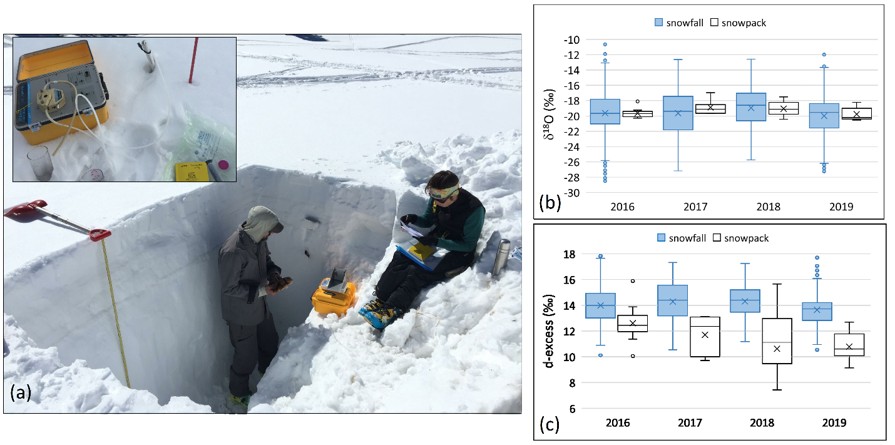
Photos courtesy of Rosemary Carroll. Stable water isotope sample collection for (a) snowpack, and (inset) snowmelt. A comparison of annually averaged isotopic values for winter snowfall and snowpack at sample locations during peak snow water equivalent for (b) δ18O and (c) d-excess. ×=mean value.
The Science
Isotopes are elements that have a different number of neutrons than protons, which allows them to be used as tracers to understand how different materials move throughout an environment. Scientists collected stable water isotopic information over a five-year period in a large Colorado watershed, with data spanning different elevations, vegetation types, and seasonal climates. The data was combined with a land-surface model for daily estimates of snowfall and climate at sample locations. The study showed how landscape position and annual climate control snow water isotopic inputs across the watershed.
The Impact
Stable isotopes of water are used as a tracer to better understand how water moves through an ecosystem. In mountain systems dependent on snow, it is difficult to obtain adequate data to understand how snow accumulation and melt affect isotopic inputs. Using a large stable water isotope dataset across a large mountain basin, this study found that elevation is the dominant control on snowmelt isotopic inputs. Elevation controls snow presence and absence, the change in precipitation’s isotopic signature with altitude, and precipitation phase changes from snow to rain. Transformations to snowpack isotopic signature due to melt-freeze cycles and vapor loss were found significant at lower elevations where temperatures are warmer and snowpack accumulation is shallow.
Summary
Stable water isotopes are used as natural tracers to assess water sourcing to vegetation water use, groundwater replenishment and stream water export. Mountainous watersheds have strong variability in snowpack accumulation and snowmelt and this variability may affect the accuracy of using water isotopes as tracers. However studies that assess how water isotopes vary in the snowpack and snowmelt are limited in mountain environments. Over a five-year period, researchers collected the largest known snow water isotope dataset within a mountainous watershed. Isotopic inputs in snowfall, adjusted for altitude, described most of the snowpack isotopic variability. North and east facing slopes act as a secondary control through vapor loss of persistent snowpack in the early winter. Melt-freeze cycles and vapor loss back to the atmosphere altered the isotopic signature of snowpack. This occurred where and when air temperatures were high and snow accumulation was low. Overall, observed data indicate that elevation is the dominant control on snow water isotopic inputs to mountainous basins. Elevation dictates the timing of snow accumulation and melt, the rate of isotopic change in precipitation with altitude, and the effect of vapor loss on snowpack isotopes. Studies in mountain environments will require adjustment for elevational controls to properly understand water sourcing of stable water isotopes from snowmelt.
Contact
Rosemary WH Carroll, Lead Author
Desert Research Institute, Reno, NV
rosemary.carroll@dri.edu
Eoin Brodie, Kenneth Williams
Lawrence Berkeley National Laboratory
elbrodie@lbl.gov, khwilliams@lbl.gov
Funding
U.S. Department of Energy Office of Science under contract DE-AC02-05CH11231 as part of Lawrence Berkeley National Laboratory Watershed Function Science Focus Area.
Publications
, , , , , , , , , & (2022). Variability in observed stable water isotopes in snowpack across a mountainous watershed in Colorado. Hydrological Processes, 36(8), e14653. https://doi.org/10.1002/hyp.14653
R. Carroll, W. Brown, A. Newman, C. Buetler, K.H. Williams, “East River Watershed Stable Water Isotope Data in Precipitation, Snowpack and Snowmelt 2016-2020”. (2021). [https://data.ess-dive.lbl.gov/view/doi:10.15485/1824223] (data package)