
New data shows how aspen trees adjust their water uptake from shallow to deep, snowmelt-fed soil layers to maintain transpiration during dry periods
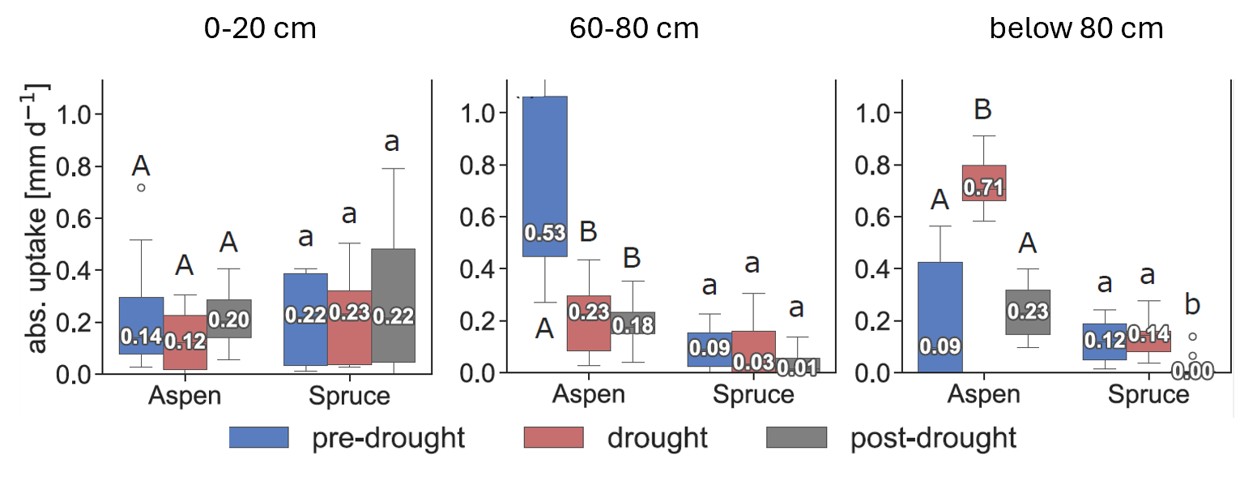
Aspen trees mainly used infiltrated rainwater from about 60 cm depth before drought onset (blue), but switched their dominant uptake to depths below 80 cm during a dry period (red). After the drought (grey) the uptake of aspen trees from the topsoil doubled, while the uptake from below 80 cm was three times smaller. Image courtesy of Matthias Sprenger.
The Science
Trees need water to survive, but how do they get it when the soil is dry? We used novel tools to track water sources of aspen and spruce trees on a daily basis. Aspen trees showed they could switch water sources fast. When the soil near the top dried out, aspen rapidly changed to pulling water from deep soil layers (below 60 cm). Both tree types mainly used old snowmelt water stored deep underground to survive dry summers. When heavy rain fell, they quickly switched back to using water from the top soil.
The Impact
These findings highlight how important snowmelt storage in deeper soil layers is for helping forests to keep transpiring during drought conditions. Over the coming decades, less snow is expected, making this deep water crucial for forest resilience in the Western US. This research is important for water resources management, because it shows that most summer rainfall is used quickly by trees (transpiration). Thus, summer rain contributes relatively little to refilling groundwater or streams in the headwaters of the Upper Colorado River.
Summary
Researchers utilized novel daily in situ measurements of stable isotopes (2H and 18O) in soil and tree stem water, alongside sap flow and soil matric potential measurements, to study water uptake dynamics in subalpine aspen and Engelmann spruce trees in the East River watershed, Colorado. This high-resolution approach revealed that aspen trees compensate for the lack of water in shallow soil layers during dry conditions by switching their uptake to deeper depths. Specifically, when the upper 60 cm of soil dried during a drought period, aspen increased their absolute water uptake volume from deep layers (beneath 80 cm) by a factor of seven compared to pre-drought conditions. The deep uptake source, primarily snowmelt stored in the subsoil, serves as the major reserve sustaining transpiration. Spruce trees exhibited lower overall transpiration rates and less distinct source shifting. This difference occurred partly because the spruce canopy intercepted much of the rainfall, limiting infiltration into the shallow soil. Although aspen compensated for shallow dryness, the deep uptake was not sufficient to fully offset the lack of water, leading to reduced transpiration rates and potential stress during severe dry periods.
Contact
Matthias Sprenger
Earth and Environmental Science Area, Lawrence Berkeley National Laboratory
msprenger@lbl.gov
Eoin L. Brodie, Watershed Function SFA LRM
Lawrence Berkeley National Laboratory
Funding
This work was supported by the Laboratory Directed Research and Development Program of Lawrence Berkeley National Laboratory, the Watershed Function Science FocusArea under U.S. Department of Energy Contract DE‐AC02‐05CH11231, the Department of Energy Visiting Faculty Program, the France‐Berkeley Fund, and the Department of Energy Award DESC0023029.
Publications
Sprenger M., Seeger S., Berkelhammer M., Bogie N.A., et al., Opportunistic Short-Term Water Uptake Dynamics by Subalpine Trees Observed via In Situ Water Isotope Measurements. Water Resources Research 61(8), e2024WR039171 (2025). [DOI:10.1029/2024WR039171]
Sprenger M., Seeger S., Berkelhammer M., Daily water stable isotopes, transpiration, and matrix potential data for an aspen and engelmann stand in the East River Watershed (version 2). [Dataset] ESS-DIVE, [DOI: 10.15485/2462766]