
Deep learning models to simulate soil water flux velocity, trained on high-frequency soil moisture observations, reveal the importance of rainfall characteristics and an increase of flux by the end of the century.
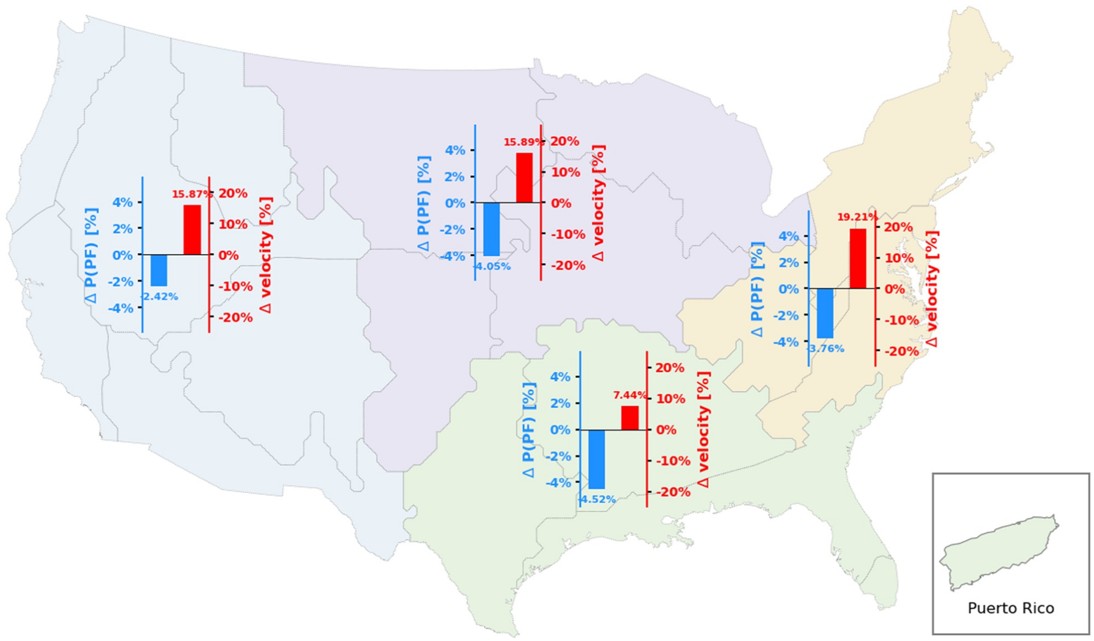
Image courtesy of Li et al. (2026)
Relative change [%] of the probability of preferential flow occurrence (blue bars) and changes in soil water velocity (red bars) in four US regions between historical (1980–2019) and end of century (2060–2099) projections.
The Science
Rain does not always soak into soil evenly. Sometimes water rushes through cracks and wormholes, skipping past most of the soil. Scientists call this “preferential flow.” This flow is generally hard to predict. Researchers built a deep learning model that learns from data. They used soil moisture and rainfall records from 33 sites across the U.S.. The model predicted well whether this fast flow would happen. It struggled more to predict exact speed of the flow. Rainfall amount and length mattered most. Contrary to what most process-based models predict, sandy soil showed slower fast-flow than clay-rich soil. Future meteorological conditions will not make fast flow happen more often, but it will make it move faster.
The Impact
When water rushes through soil quickly, it skips the soil’s natural filtering process. This means pollutants and nutrients can reach groundwater faster and in larger amounts. As the atmosphere warms, this fast water movement is expected to speed up, even without happening more often. This matters for drinking water safety, farming, and water supply planning. It also matters for large scale Earth models, since these simulations usually assume that water moves slowly and evenly through soil. The new results will help scientists build better models, which will enable better decisions about protecting water resources in the future.
Summary
Researchers built a deep learning model to predict soil water flow using high-frequency soil moisture and precipitation data from 33 sites across the National Ecological Observatory Network. The model accurately predicted whether fast, uneven water movement, known as preferential flow, would occur during a storm, though it was less precise at predicting exact flow speed. Rainfall duration, volume, and intensity were the strongest predictors. Soils with more clay showed higher water velocities than sandy soils, contradicting traditional uniform-flow assumptions used in most hydrology models. Applying the model to future meteorological conditions through 2099 showed that flow velocities through these pathways could increase by 7 to 15 percent, even though the frequency of preferential flow itself is not expected to rise substantially. The findings suggest that future conditions will make existing fast-flow pathways more efficient at transporting water, nutrients, and potential contaminants toward groundwater, with implications for water quality models used across hydrology, agriculture, and Earth system science.
Contact
Matthias Sprenger
Department of Forestry and Environmental Resources, North Carolina State University
Earth and Environmental Science Area, Lawrence Berkeley National Laboratory
mspreng@ncsu.edu
Eoin L. Brodie, Watershed Function SFA LRM
Lawrence Berkeley National Laboratory
Funding
This work was supported by the Watershed Function Science Focus Area under U.S. Department of Energy Contract DE‐AC02‐05CH11231 and the Consortium of Universities for the Advancement of Hydrologic Science, Inc. (CUAHSI) and the John Wesley Powell Center for Analysis and Synthesis, funded by the U.S. Geological Survey.
Publications
Li, B., Sprenger, M., Araki, R., Keen, R., et al., Dominant controls on preferential flow and their implications for future soil water fluxes. Earth’s Future 52(19), e2025GL118045 (2026). [DOI: 10.1029/2026EF008296]
Li, B., Sprenger, M., Wyatt, B. M., Gimenez, D., et al. NEON soil preferential flow database. [Dataset] HydroShare. (2024) [DOI:10.4211/hs.a447dc8a74f44736bf3fe217c9228005]