
Identify when, where, and how preferential flow occurs by examining six methodologies that utilize widely available, high-frequency soil moisture data
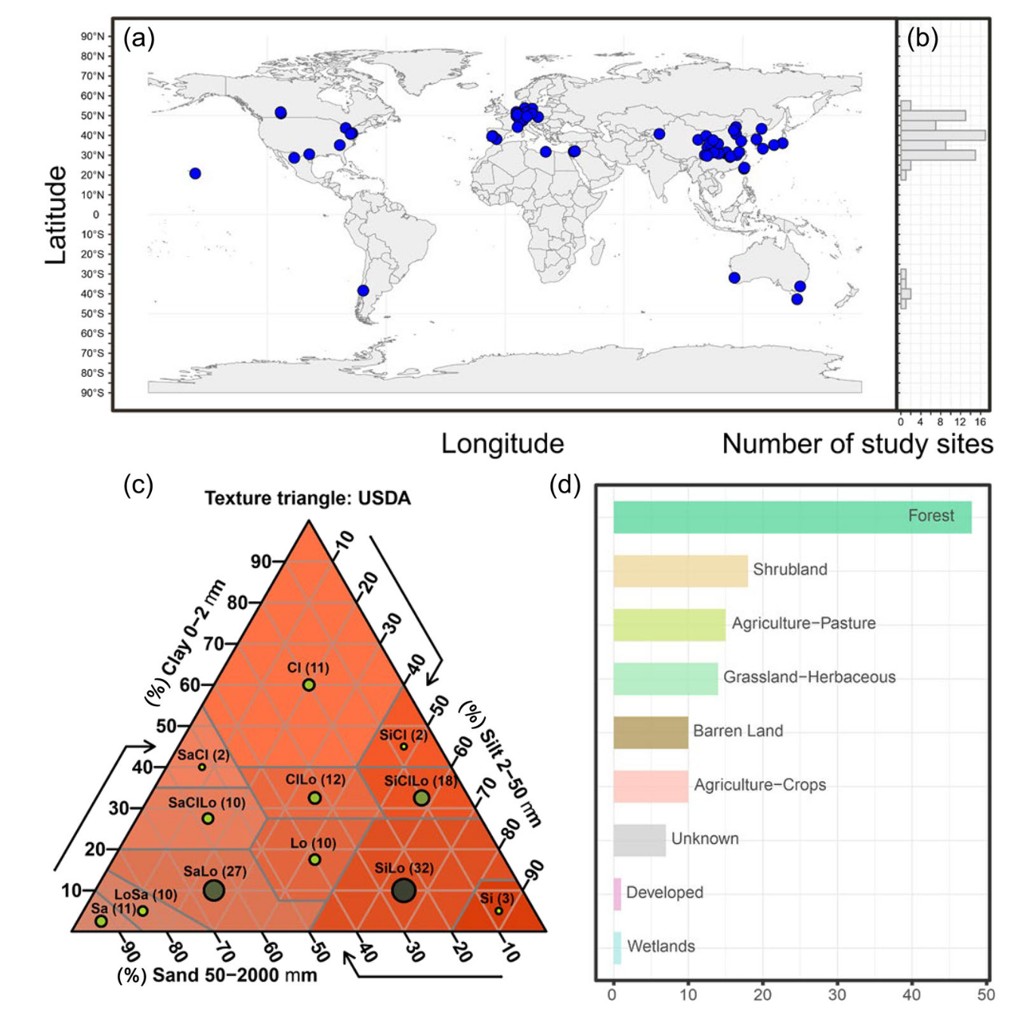
Image courtesy of Nimmo et al. (2025)
(a) World map of preferential flow studies included in the review; (b) the distribution of sites by latitude; (c) the corresponding soil texture classes from each study, in which the size of the circles is proportional to the number of studies in that class; and (d) the number of instances where particular land cover types are present at the particular sites.
The Science
Some rainwater infiltrates into the ground slowly and evenly, but often, some of the rainwater takes fast, narrow paths deep into the soil. We call this rapid movement preferential flow and this fast flow affects how groundwater gets recharged and how pollutants are transported. This work reviewed many ways scientists use soil moisture sensors to observe water content changes in the soil over time. We classified six methods for spotting preferential flow based on soil moisture sensor data. These methods help us learn when and where this important fast flow occurs underground.
The Impact
This research evaluates methods to detect preferential flow using data from common soil sensors. Accurately tracking this water is critical for managing groundwater supplies and predicting how nutrients and pollutants move through the sub surface. It also helps scientists model flood risks and how ecosystems respond to climate change. This work impacts water resource management, environmental engineering, and agriculture by improving our ability to see where water goes underground outlining clear guidelines on methods to do so.
Summary
Preferential flow describes the rapid movement of water through distinct subsurface pathways, such as macropores or fractures, effectively bypassing the surrounding soil matrix. This review evaluates methodologies for identifying preferential flow utilizing data from high-frequency soil moisture time series, synthesizing results from 77 studies. The authors classified detection techniques into six categories, including Nonsequential Response, Velocity Threshold, flow-pattern heterogeneity, trajectory of water content increase, water balance calculations, and flow-model comparisons.
The analysis highlights that while commonly used methods like Nonsequential Response and Velocity Threshold are feasible with limited instrumentation, they differ significantly in their susceptibility to errors, such as false negatives, and often rely on subjective judgment to establish detection thresholds. By applying these analytical algorithms to long-term datasets from extensive soil moisture monitoring networks, researchers can determine the timing, location, and initiating conditions of preferential flow events. This work provides a framework for selecting appropriate methods to better understand how water, nutrients, and contaminants move through the vadose zone.
Contact
Matthias Sprenger
Department of Forestry and Environmental Resources, North Carolina State University
Earth and Environmental Science Area, Lawrence Berkeley National Laboratory
mspreng@ncsu.edu
Eoin L. Brodie, Watershed Function SFA LRM
Lawrence Berkeley National Laboratory
Funding
This work was supported by the Watershed Function Science Focus Area under U.S. Department of Energy Contract DE‐AC02‐05CH11231, the Consortium of Universities for the
Advancement of Hydrologic Science, Inc. (CUAHSI) and the John Wesley Powell Center for Analysis and Synthesis, funded by the U.S. Geological Survey.
Publications
Nimmo, J.R., Wiekenkamp, I., Araki, R., Groh, J., et al., Identifying preferential flow from soil moisture time series: Review of methodologies. Vadose Zone Journal 24(2), e70017 (2025). [DOI: 10.1002/vzj2.70017]