
High-frequency soil moisture data from 40 NEON sites show that preferential flow occurs in up to 60% of rainfall events and is driven by rainfall intensity, soil texture, and vegetation.
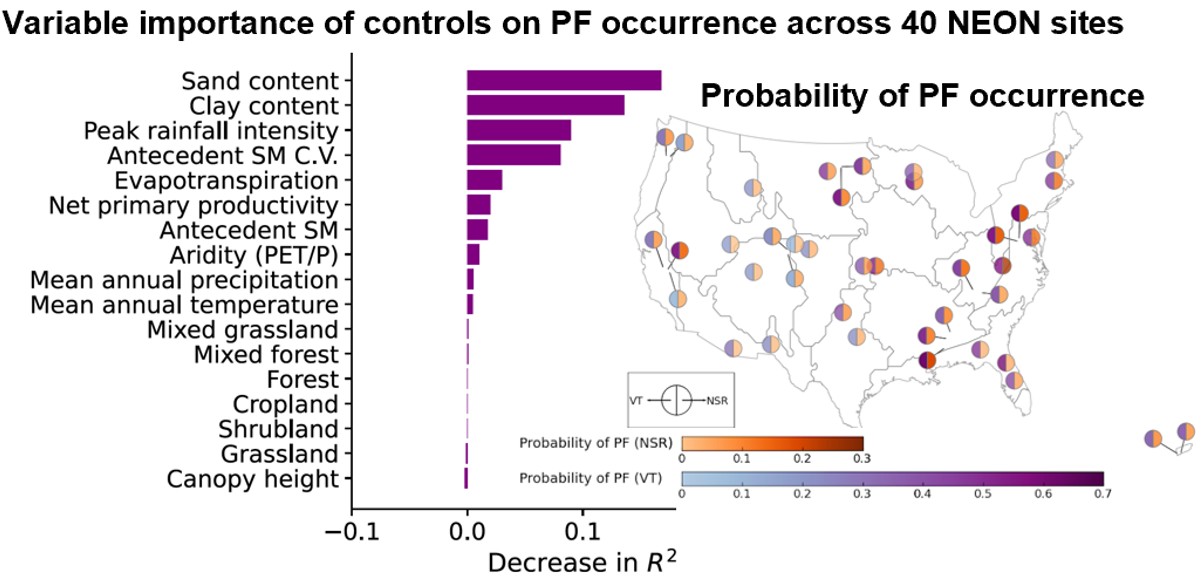
Image courtesy of Li et al. (2025)
Bar plot showing the feature importance of random forest models in estimating Preferential flow (PF) occurrence. Map showing the occurrence of PF across 40 National Ecological Observatory Network sites. The probability of PF is calculated as a ratio of the number of precipitation events (≥2 mm) that triggered PF to the total number of precipitation events (≥2 mm). The left side of each circle contains the PF probability for the velocity threshold (VT) criterion, while the right side represents the result from the non‐sequential response (NSR) criterion.
The Science
Our research investigated the movement of water through soil, revealing that it does not always seep evenly through the ground. Instead, water often flows rapidly through specific pathways, such as cracks or channels, while bypassing surrounding soil. This phenomenon, known as preferential flow, was found to occur widely across various soil types and climates. This preferential flow was most likely to occur at sites with heavy rainfall and clayey soils.
The Impact
Understanding preferential flow of water in soils is essential for effective water management and environmental conservation, as it influences groundwater recharge and water quality.
Preferential flow speeds up how rain becomes groundwater or reaches streams and thus can also move nutrients and pollution quickly. Our work helps show where and when this fast flow is likely to occur. This can guide how we protect drinking water and improve models that predict floods and droughts. It also helps us plan for a future with stronger storms and changes in plant growth, which will likely increase the occurrence of preferential flow
Summary
This research quantified the spatiotemporal occurrence and controls of preferential flow by analyzing high-frequency, multi-depth soil moisture data from 40 National Ecological Observatory Network (NEON) sites across 17 U.S. ecoregions. Preferential flow was found to be ubiquitous, occurring in up to 60% of all observed rainfall events ≥2 mm. Researchers leveraged high-frequency data from approximately 1,500 sensors over several years.
Using machine learning models, consistent factors were identified as primary determinants of preferential flow occurrence, regardless of the detection method used. The likelihood of preferential flow steeply increases with peak rainfall intensity, showing a critical threshold-like behavior between moderate and heavy rainfall. Preferential flow is also more likely in soils with a finer texture (higher clay content), which promotes the development of soil structure and macropores. Additionally, conditions of low variability in antecedent soil moisture and higher net primary productivity increase preferential flow likelihood. These findings address a long-standing challenge in hydrology by providing a continental-scale foundation for incorporating preferential flow into hydrological and biogeochemical models, which is crucial for addressing future changes in water and nutrient cycling.
Contact
Matthias Sprenger
Department of Forestry and Environmental Resources, North Carolina State University
Earth and Environmental Science Area, Lawrence Berkeley National Laboratory
mspreng@ncsu.edu
Eoin L. Brodie, Watershed Function SFA LRM
Lawrence Berkeley National Laboratory
Funding
This work was supported by the Watershed Function Science Focus Area under U.S. Department of Energy Contract DE‐AC02‐05CH11231 and the Consortium of Universities for the Advancement of Hydrologic Science, Inc. (CUAHSI) and the John Wesley Powell Center for Analysis and Synthesis, funded by the U.S. Geological Survey.
Publications
Li, B., Sprenger, M., Wyatt, B. M., Giménez, D., et al., Ubiquity and causes of soil water preferential flow across 17 ecoregions. Geophysical Research Letters 52(19), e2025GL118045 (2025). [DOI: 10.1029/2025GL118045]
Li, B., Sprenger, M., Wyatt, B. M., Gimenez, D., et al. NEON soil preferential flow database. [Dataset] HydroShare. (2024) [DOI:10.4211/hs.a447dc8a74f44736bf3fe217c9228005]