
Variations in bedrock and vegetation cover affect subsurface water flow dynamics of a mountainous hillslope.
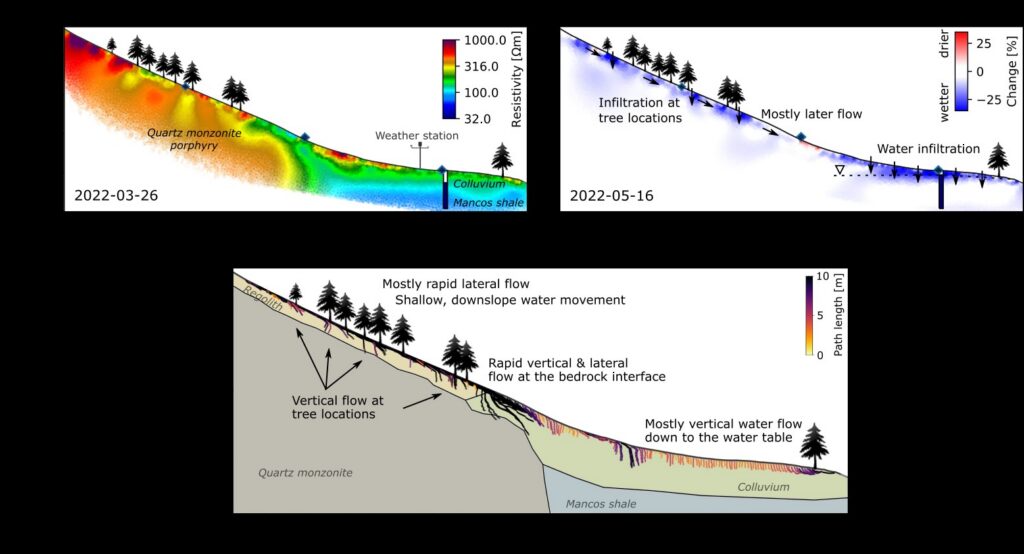
Geophysical monitoring data from a mountainous hillslope in Colorado show variation in bedrock type expressed by electrical resistivity (top left), and changes in resistivity related to wetting of the subsurface during snowmelt (top right). The bottom shows modeling results highlighting the variable flow paths that characterize the different bedrock areas.
The Science
A multi-institutional team of researchers studied how water moves through a mountainous hillslope during snowmelt and rain. They buried sensors, and used geophysical imaging and weather data to track water flow above- and below-ground. The studied hillslope had two parts: a steep rocky upper section with tall trees, and a gentler lower section with deeper soil that was mostly covered by meadow plants. The team found that water on the steep slope moved mostly sideways through shallow layers of soil, except where trees were rooted. These roots and cracks in the rock seemed to channel water down deeper. On the lower, flatter section, water moved mostly up and down, soaking deeper into the soil. This study showed that the shape of the land and what’s underneath the surface strongly affect how water flows through a hillslope. Even over short distances, these differences were found to create very different water movement patterns.
The Impact
As Earth’s climate changes, understanding water flow through hillslopes is critical to protect freshwater resources. The knowledge gained from this study helps to better predict how changes in rainfall patterns and snowmelt will affect water resources, both in terms of quantity and quality. By knowing how water travels through hillslopes, it is easier to predict how much water reaches streams and rivers during different seasons. This understanding of water movement also helps explain how much water may be stored and how it becomes available to plants. This helps preparations for floods during heavy rain or snowmelt, and droughts during dry periods. The way water moves through the soil also affects its quality. Understanding these pathways enables prediction of where contaminants might end up and how to manage them.
Summary
Predicting the hydrological response of watersheds to climate disturbances requires a detailed understanding of the processes connecting the below-ground water in hillslopes with streams. Using a network of soil moisture and temperature sensors, electrical resistivity tomography monitoring, and a weather station, a multi-institutional research team led by the Lawrence Berkeley National Laboratory (LBNL) monitored above and below-ground water driving the hydrological response of a mountainous hillslope in Colorado during snowmelt and the summer monsoon season. The hillslope transect covered bedrock and vegetation gradients, with a steep upper part characterized by shallow bedrock, and a gentle lower part underlain by colluvium. Conifers were the main vegetation cover on the upper part of the hillslope, with grass and veratrum on the lower part. Combined with a simplified hydrological model, the team showed that the thin soil layer of the steep slope acts as a preferential flow path, leading to mostly shallow lateral flow, interrupted by vertical flow, mostly where trees were located. This vertical flow is likely facilitated by movement of water along bedrock fractures and the plant roots. Vertical flow and upstream-driven groundwater dynamics prevail at the colluvium, presenting a very different hydrological behavior compared to the upper part. These results show that subsurface structure and features have a strong control on the hydrological response of a hillslope and that those can create considerably varying hydrological dynamics across small spatial scales.
Contact
Sebastian Uhlemann
Lawrence Berkeley National Laboratory
Baptiste Dafflon
Lawrence Berkeley National Laboratory
Funding
This material is based upon work supported as part of the Watershed Function Scientific Focus Area funded by the U.S. Department of Energy, Office of Science, Office of Biological and Environmental Research under Award DE-AC02-05CH11231.
Publications
Uhlemann, S., Peruzzo, L., Chou, C., Williams, K. H., Wielandt, S., Wang, C., … & Dafflon, B. (2024). Variations in bedrock and vegetation cover modulate subsurface water flow dynamics of a mountainous hillslope. Water Resources Research, 60(2), e2023WR036137. DOI: https://doi.org/10.1029/2023WR036137