
Deep Groundwater Sustains Mountain Streamflow During Drought
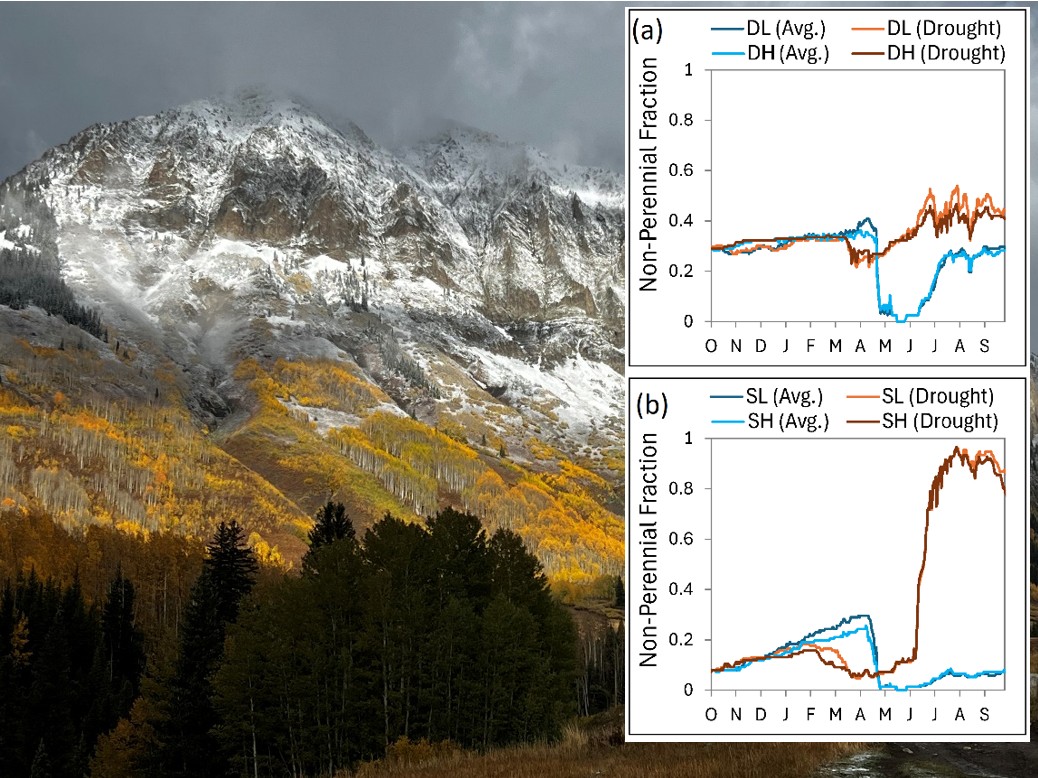 |
Right: Fraction of the mountain stream network that goes dry (or non-perennial) in year-1 of average and drought conditions: (a) deep circulating groundwater, (b) shallow circulating groundwater. DL = deep, 1% porosity, SL = shallow, 1% porosity, DH = deep, 3% porosity, SH = shallow, 3% porosity. Left/background: Image of Gothic Mountain, CO. Image courtesy of Rosemary Carroll.
The Science
Mountain streams get their water from rain, snow, and underground water. When there is a drought, streams can dry up. This study looked at how deep underground water helps keep streams flowing. Researchers used a computer model to test two cases: one where water stays near the surface and one where it moves deep underground. Shallow groundwater drains quickly, making streams dry up for months. Deep groundwater lasts longer and keeps streams flowing, but it takes years to refill. Knowing this helps predict water shortages and protect streams during droughts.
The Impact
This research helps understand how mountain streams survive droughts. It shows that deep underground water can keep streams flowing, but it takes a long time to refill. This is important for people who manage water supplies and protect fish. Farmers, cities, and power plants all need steady water. Knowledge of how water moves underground can enable better planning for the future. This study also helps scientists improve water models, making it possible to predict drought effects more accurately and find ways to keep rivers and streams healthy.
Summary
Mountain streams rely on surface runoff, lateral flow through the soil zone and groundwater to keep flowing. During droughts, there is the potential for streams to go dry to affect water availability and ecosystem function. This study explored how the depth of groundwater flow affects stream survival during prolonged drought in a mountain catchment dependent on snowpack. Using a detailed computer model, we compared two types of groundwater systems: shallow, where groundwater travels just below the land surface, and deep, where groundwater travels hundreds of meters below ground.
The results showed that shallow systems drain quickly, causing streams to dry up for months. In contrast, deep systems act as a natural reservoir, slowly releasing water and keeping streams flowing. However, these deeper systems take much longer to recover after a drought, meaning they may not be ready for the next dry period. This research highlights the importance of understanding groundwater storage and movement in mountain regions. By improving models of streamflow response to drought, scientists can help water managers make better decisions about conservation and supply planning. The findings also suggest that measuring deep bedrock properties could lead to more accurate predictions of water availability, benefiting ecosystems and communities that depend on mountain streams.
Contact
Rosemary W.H. Carroll
Desert Research Institute
2215 Raggio Parkway
Reno, NV 89512
rosemary.carroll@dri.edu
Eoin L. Brodie, Watershed Function SFA LRM
Lawrence Berkeley National Laboratory
Funding
Work was supported as part of the Watershed Function Science Focus Area funded by the US Department of Energy, Office of Science, Office of Biological and Environmental Research under Contract No. DE-AC02-05CH11231. Salary support was provided to Dr. Manning by the U.S. Geological Survey’s Mineral Resources Program.
Publications
Carroll, R. W., Manning, A. H., Williams, K. H., “The role of bedrock circulation depth and porosity in mountain streamflow response to prolonged drought”. Geophysical Research Letters, 52, e2024GL112927, (2025). [https://doi.org/10.1029/2024GL112927]
Data publication: Carroll, R., and Williams, K.H., “Groundwater and Surface Water Flow (GSFLOW) model files to explore bedrock circulation depth and porosity in Copper Creek, Colorado”. Environmental System Science Data Infrastructure for a Virtual Ecosystem; Watershed Function SFA. (2024). [https://doi.org/10.15485/2453885]