
Very small changes in concentrations of the trace element river thorium provide new insight into how bedrock fractures are created and how they function.
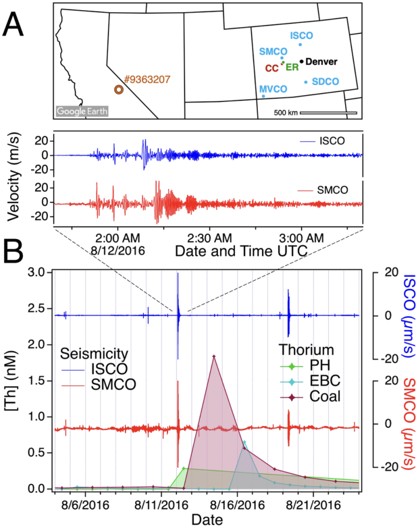
Image from Fig. 4 of Gilbert et al. 2023, Creative Commons Attribution 4.0 International License
Image A: Map of the western United States showing the location of the East River (ER) and Coal Creek (CC) in Colorado, seismic monitoring stations and the epicenter of a seismic event. #9363207. Earth. Image B: Example of seismic activity that occurred before thorium excursions in ER and CC that was recorded at two stations in Colorado and attributed to cataloged (seismic) event #9363207.
The Science
Fractures in bedrock are the pathways for underground water flow and thus enhance the breakdown of rocks. Fractures therefore provide an important but hidden flow of water and dissolved elements into rivers. Because detecting fractures in the rock beneath our feet is difficult, scientists don’t know much about how often they are created or when they move. We recently discovered that sudden increases in the concentration of very dilute elements such as thorium in river water can provide a new signature of fracture creation or motion.
The Impact
Understanding how and why bedrock fractures is important for monitoring element and water flow into rivers. Our findings suggest that very dilute elements in rivers can provide a new way to detect events that result in bedrock fractures and change underground flow pathways because these changes temporarily increase element concentrations. Most fracture changes detected in this study occurred without any detectable cause. However, some fracture processes may have been triggered by very small ground motions caused by an earthquake hundreds of kilometers away.
Summary
Fractures are integral to the hydrology and geochemistry of watersheds, but understanding fracture dynamics is challenging because of the difficulties that come with monitoring the subsurface. We provide evidence that long-term, high-frequency measurements of river concentrations of the ultra-trace element thorium (Th) can provide a signature of bedrock fracture processes spanning neighboring watersheds in Colorado. River Th concentrations show abrupt (subdaily) excursions and biexponential decay with approximately 1-day and 1-week time constants, concentration patterns that are distinct from all other solutes except beryllium and arsenic. The patterns are uncorrelated with daily precipitation records or seasonal trends in atmospheric deposition, but are consistent with bedrock release and dilution upon mixing with river water. Most Th excursions have no seismic signatures that are detectable 50 km from the site, suggesting the Th concentrations can reveal aseismic fracture or fault events. We find, however, a weak statistical correlation between Th and seismic motion caused by distant earthquakes, possibly the first chemical signature of dynamic earthquake triggering, a phenomenon previously identified only through geophysical methods.
Contact
Benjamin Gilbert
Lawrence Berkeley National Laboratory
Eoin L. Brodie, Watershed Function SFA LRM
Lawrence Berkeley National Laboratory
Funding
This work was conducted as part of the Watershed Function Scientific Focus Area at Lawrence Berkeley National Laboratory and was supported by the US Department of Energy (DOE) Subsurface Biogeochemical Research Program, DOE Office of Science, Office of Biological and Environmental Research, under contract no. DE-AC02 − 05CH11231.
Publications
Gilbert, B., Carrero, S., Dong, W., Joe-Wong, C., Arora, B., Fox, P., Nico, P. S. and Williams, K. H. “River thorium concentrations can record bedrock fracture processes including some triggered by distant seismic events” Nature Communications 14, 2395 (2023) https://doi.org/10.1038/s41467-023-37784-3