
A review of the catchment-scale transit time estimation literature to synthesize the developments in this field and the challenges going forward.
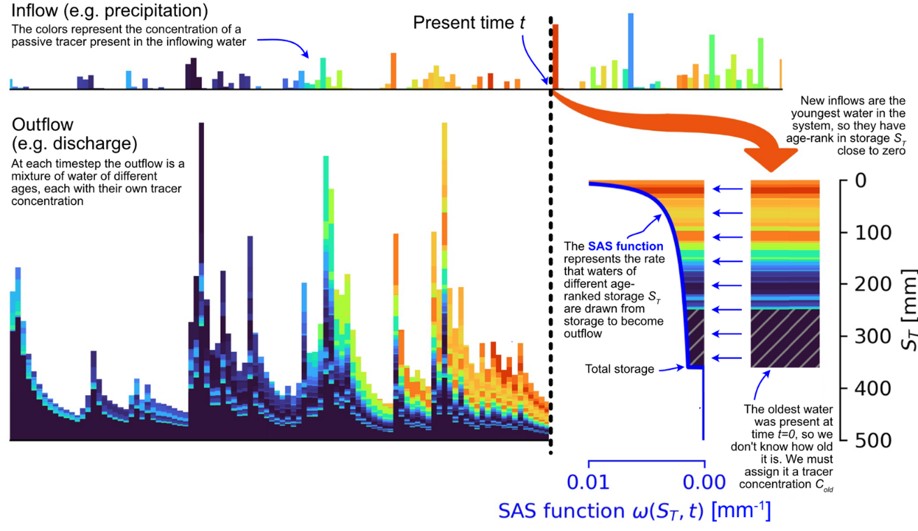
Illustration of the water age balance using a transport column analogy with age-ranked storage (ST). ω(ST,t) is the Storage Age Selection (SAS) function describing the flux from storage to outflow. An animation is here: https://youtu.be/WBYy_iDPRv0.
The Science
Water transit time is the amount of time a water particle stays within a hydraulic system, from the time it enters to the time it leaves through discharge or evaporation. We summarize the basic theory of water transit time estimations, including definitions, assumptions, and tracer hydrological requirements, while also synthesizing the latest developments in the field. This study presents a method to relate water storage to fluxes (water flowing in or out of a system) that are represented by SAS functions, while also assessing the share of recent rainfall in stream water. The study also presents current challenges, ranging from the age of evapotranspiration fluxes to incorporating new tracer data and upscaling methods. We outline next steps, which entail theoretical advancements as well as developments in modeling and tracer techniques.
The Impact
Climate change is expected to impact the water cycle, resulting in more intense and frequent flooding and droughts, thus accurately estimating transit time is essential to understand water functioning and availability in a changing climate. We provide the current state of water transit time methods in catchment hydrology, helping to make these methods more widely accessible to the larger hydrology community. The work aims to eventually fully merge transit time research into the mainstream of hydrology. This can advance the mechanistic understanding and model representation of water flow paths in catchments.
Summary
Water transit time is a standard measure in catchment hydrological and ecohydrological research. Over the last 15 years, the field has largely expanded with new data, theory and applications. In this article, the research team reviews new developments with a focus on water-age-balance approaches and data-based approaches. We discuss and compare methods involved in this field, including direct transit time estimates from controlled experiments and water age tracking through models. This paper helps to unify some of the heterogeneity in the literature that has crept in with new approaches in an attempt to clarify the key differences and similarities among them. We point to open questions in transit time research, including what is still needed from theory, models, field work, and community practice.
Contact
Matthias Sprenger
Lawrence Berkeley National Laboratory
msprenger@lbl.gov, 404-804-1116
Eoin L. Brodie, Watershed Function SFA LRM
Lawrence Berkeley National Laboratory
Funding
This work was supported by the US Department of Energy Office of Science under contract DE-AC02-05CH11231 as part of Lawrence Berkeley National Laboratory Watershed Function Science Focus Area.
Publications
Benettin P. et al., “Transit Time Estimation in Catchments: Recent Developments and Future Directions”, Water Resources Research, 58, e2022WR033096, (2022) [doi.org/10.1029/2022WR033096]