
Researchers use watershed reactive modeling to assess water quantity and quality changes in a mountainous watershed.
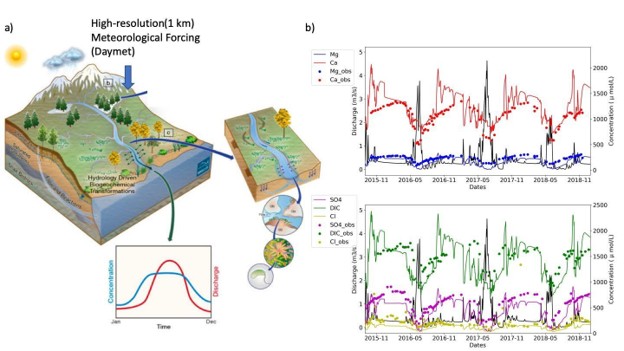
Figure 1: a) The response of mountainous watersheds to rain and snow dynamics under a changing climate involves a variety of processes occurring across scales and subsystems (bedrock, hillslopes, floodplains, land-water interfaces) (Hubbard et al., 2018). b) Comparison between observed and simulated Concentration-Discharge responses at the watershed outlet.
The Science
Climate change significantly impacts freshwater quantity and quality–especially in mountainous watersheds like the Upper Colorado River Basin that are key for water supply in downstream regions of the western U.S. Researchers used a mathematical model to quantify the movement of water and chemicals under changing weather and climate conditions. This is a first-of-its-kind numerical model that simulates hydrology and chemical transport processes at high resolution in a mountainous watershed.
The Impact
The Colorado River provides water for more than 40 million people, highlighting the urgent need to study and understand how climate change may impact the watershed’s water quality and quantity. This study’s results show that changing rainfall and early snowmelt in the Upper Colorado River Basin affect both the volume of water and the mineral reactions that take place, impacting water quality observed downstream. The three-dimensional model makes it possible to understand how the watershed’s topography, stream water flow, and groundwater interact in time and in space. The model demonstrates that north-and south-facing slopes of the river valley contribute differently to observed effluent concentrations. The effects are relatively small in this study but could become enhanced with larger climate variability.
Summary
The researchers studied how changing environmental factors that determine surface and subsurface water flow affect chemical transport in a watershed ecosystem. The team analyzed the relationship of the volume of water flow and concentration of chemicals, or Concentration-Discharge relationship, to develop a predictive understanding of exports from the watershed to the larger river basin. The developed model simulates integrated hydrological transport and reaction processes in both surface and subsurface water. Simulation results also show that the model can resolve changes in snowmelt and infiltration associated with spatial variability throughout the watershed. Additionally, the model captures the annual changes in the Concentration-Discharge relationship between wet and dry years, and demonstrates how changing infiltration in time and space affects mineral weathering, which contributes to the observed effluent concentrations. Overall, this newly developed model can account for spatial variability that impacts water availability and increase understanding of how the volume of flowing water and concentration of chemicals impact water quality and quantity.
Contact
Zexuan Xu
Lawrence Berkeley National Laboratory
zexuanxu@lbl.gov, (510) 486-5128
Eoin L. Brodie, Watershed Function SFA LRM
Lawrence Berkeley National Laboratory
Funding
This work is supported by the Watershed Function Scientific Focus Area and IDEAS-Watersheds projects, funded by the U.S. Department of Energy, Office of Science, Office of Biological and Environmental Research. This work used resources of the National Energy Research Scientific Computing Center (NERSC), a U.S. Department of Energy, Office of Science.
Publications
Xu et al., Understanding the hydrogeochemical response of a mountainous watershed using integrated surface-subsurface flow and reactive transport modeling, Water Resources Research, 10.1029/2022WR032075