
Terrestrial groundwater, rather than ocean water, plays a major role in shaping geochemical conditions and ecosystem functioning in coastal marshes
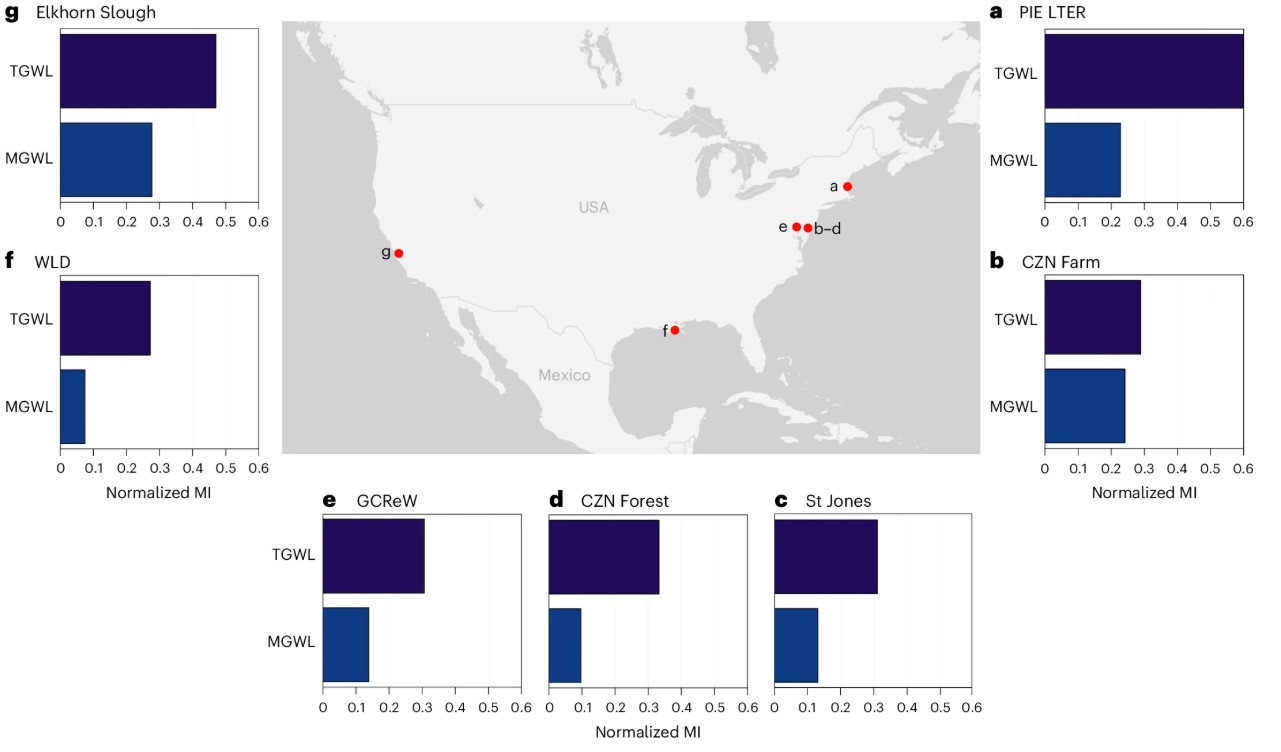
Image: Novel statistical analyses derived from DOE-sponsored research show that terrestrial groundwater level (TGWL) is the strongest driver of marsh redox potential across seven coastal marsh sites as opposed to ocean and marsh water elevation (MGWL).
The Science
While ocean inundation is often seen as the main force shaping salt marsh ecosystems, few studies consider the role of terrestrial groundwater. Our analysis of seven coastal marsh sites shows that groundwater from land influences redox potential more than marsh water levels. Using advanced statistical analyses, we found that upland groundwater plays a key role in controlling marsh geochemistry and ecosystem function, challenging the idea that ocean processes are the primary driver of salt marsh dynamics.
The Impact
Coastal wetlands are important ecosystems but face threats from the ocean, weather, and changes on land. While most studies focus on how ocean dynamics impact wetland health and function, our research highlights the hidden yet powerful role of terrestrial groundwater. We found that terrestrial groundwater directly influences redox potential, which affects carbon cycling and a wetland’s ability to withstand stress. Our study highlights the strong connection between terrestrial groundwater and coastal wetland dynamics. Our study stresses that declining groundwater in coastal areas will not only impact water supply through seawater intrusion, but also endanger the survival of coastal wetlands. We therefore conclude that future assessments of wetland survival must consider changes in groundwater levels.
Summary
This study investigates drivers of coastal wetland redox potential, a proxy for sediment biogeochemistry and oxic/anoxic transitions that influence resilience, at seven coastal wetland sites across the United States. Using advanced statistical analyses, we evaluate the influence of wetland water level, terrestrial groundwater level, and meteorological factors on redox potential. Results show that, across all sites, terrestrial groundwater level was the dominant control on redox potential. The strong link between terrestrial groundwater and coastal wetland redox potential contrasts with the traditional understanding of ocean inundation as the primary driver and suggests that terrestrial aquifers are an important driver of biogeochemical processes. Our results also suggest that changes in groundwater levels such as due to drought or pumping may affect the biogeochemical conditions and future resilience of coastal wetlands.
Contact
Julia Guimond, julia.guimond@whoi.edu, Woods Hole Oceanographic Institution
Nicholas Ward, nicholas.ward@pnnl.gov, Pacific Northwest National Laboratory
Bhavna Arora, barora@lbl.gov, Lawrence Berkeley National Laboratory
Funding
The lead author was funded by the WHOI’s Ocean Vision Program. This material is partly based upon work supported by the U.S. Department of Energy, Office of Science, Office of Biological and Environmental Research (DOE-BER) as part of the Watershed Function Scientific Focus Area under Contract No. DE-AC02-05CH11231; the Field, Measurements, and Experiments (FME) component of the Coastal Observations, Mechanisms, and Predictions Across Systems and Scales (COMPASS) under contract DE-AC05-76RL01830; the SMARTX project under awards DE-SC0014413, DE-SC0019110 and DE-SC0021112; the DOE-BER Early Career Research Program; and DOE-BER award DE-SC0022108. Other non-DOE funding support includes CDFW Climate Change Impacts on Wildlife and from a COAST Grant Development Program, the National Science Foundation Coastal Critical Zone Collaborative Network (EAR 2012484).
Publication
Guimond, J. A., Grande, E., Michael, H. A., Pratt, D., Herndon, E., Noyce, G. L., Ward, N. D., Forbrich, I., Regier, P., Berens, M. J., & Arora, B. (2025). The hidden influence of terrestrial groundwater on salt marsh function and resilience. Nature Water, 1–10. https://doi.org/10.1038/s44221-024-00384-6