
Deep-Rooted Plants Draw Water and Nutrients from Underground Rock Layers, and Drought Makes Them Go Even Deeper
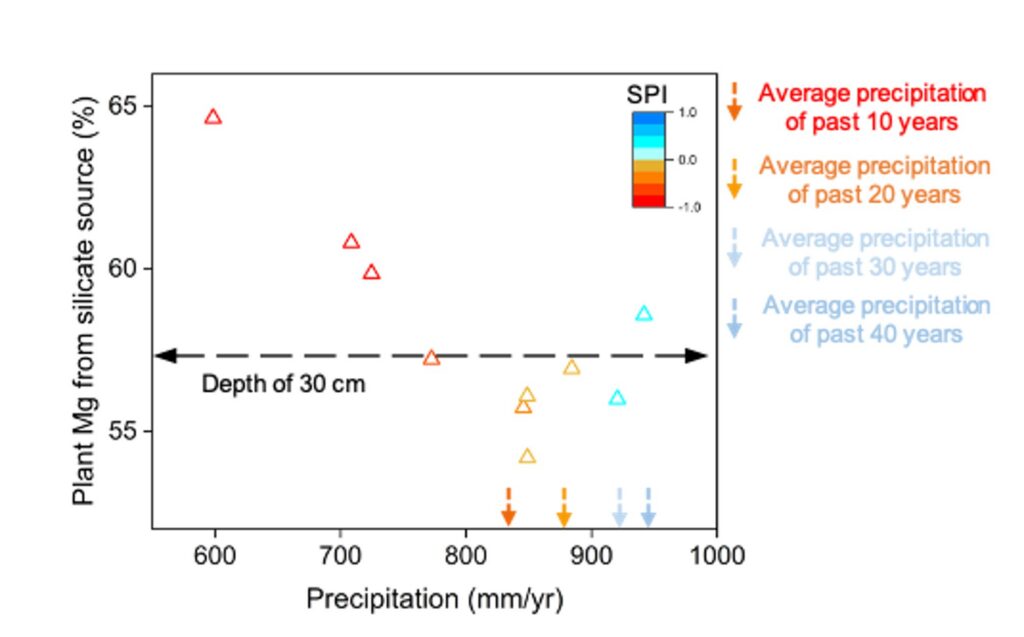
Ratio of Sagebrush Mg from deeper silicate weathering sources vs. wet precipitation.
The Science
Scientists studied three deep-rooted plants — sagebrush, lupine, and sunflower — alongside shallow-rooted grass in a Colorado mountain meadow. By analyzing chemical “fingerprints” (isotopes of strontium and water) in plant leaves, soils, and rocks, they found that deep-rooted plants don’t just pull water from deep underground — they also extract minerals and nutrients from the saprolite, a crumbly layer between soil and bedrock. Critically, during dry years, these plants reach even deeper, drawing a larger share of their nutrients from rock-derived sources. A 30-year chemical record preserved in sagebrush growth rings confirmed this pattern over time.
The Impact
Changing snowpack across the western United States is resulting in more frequent droughts in mountain ecosystems, and these findings reveal a hidden feedback loop: drought forces deep-rooted plants to mine nutrients from deeper rock layers, and that increased extraction could speed up the chemical breakdown (weathering) of bedrock. This matters for watersheds that supply drinking water to millions of people, because bedrock weathering influences river chemistry. The study also suggests that deep-rooted plants play a far larger role in underground geological processes than previously recognized — a role that may intensify as droughts become more common and severe.
Summary
The research team worked along an approximately 110-meter hillslope transect at the well-studied East River watershed in Colorado, underlain by Mancos Shale. They examined four plant species: big sagebrush (Artemisia tridentata), lupine (Lupinus argenteus), sunflower (Helianthus), and shallow-rooted needlegrass. Roots of sagebrush and lupine were observed — and confirmed by X-ray tomography — to grow through cracks in the saprolite well below one meter depth.
The key scientific tool was the ratio of two strontium isotopes (⁸⁷Sr/⁸⁶Sr). Different geological sources — rainwater, phosphate minerals (apatite), and silicate rock minerals — each have a distinct isotopic “signature.” By measuring these signatures in soil layers, plant leaves, and even individual sagebrush growth rings, the team could mathematically reconstruct where each plant was getting its strontium, and by extension, other important nutrients like calcium (Ca) and magnesium (Mg).
Their mixing model showed that silicate rock weathering contributed up to ~76% of plant available magnesium in the deepest soil layers, and that sagebrush acquired roughly 20% more magnesium from silicate minerals during dry years than wet years. A precipitation threshold of roughly 770 mm/year appeared to govern whether sagebrush taps shallow (0–30 cm) or deeper (30–60 cm+) nutrient pools. The work suggests that as droughts intensify globally, deep-rooted plants could become unexpected drivers of geological change far below the surface.
Contact
Langlang Li, Lead author
Department of Earth and Planetary Science, UC Berkeley; Lawrence Berkeley National Lab
Benjamin Gilbert, senior/corresponding author
Department of Earth and Planetary Science, UC Berkeley; Lawrence Berkeley National Lab
Eoin L. Brodie, Watershed Function SFA LRM
Lawrence Berkeley National Laboratory
Funding
This work was supported by the Watershed Function Scientific Focus Area at Lawrence Berkeley National Laboratory funded by the US Department of Energy, Office of Science, Biological and Environmental Research under Contract No. DE-AC02 − 05CH11231. Use of the Stanford Synchrotron Radiation Lightsource, SLAC National Accelerator Laboratory, is supported by the U.S. Department of Energy, Office of Science, Office of Basic Energy Sciences under Contract No. DE-AC02-76SF00515. The SSRL Structural Molecular Biology Program is supported by the DOE Office of Biological and Environmental Research, and by the National Institutes of Health, National Institute of General Medical Sciences (P30GM133894).
Publications
Li, L. et al., Depth of nutrient uptake by deep-rooted plants is regulated by water availability. Proc. Natl. Acad. Sci. U.S.A. 123 (13) e2528407123, DOI: 10.1073/pnas.2528407123 (2026).